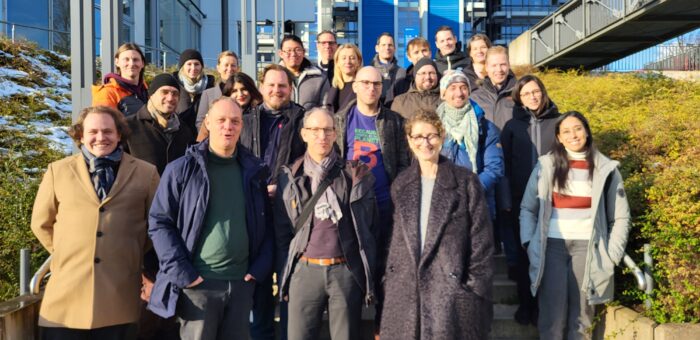
Recap on the webinar on Highly-Informative Learning Analytics at the DGHD

Recap on the webinar on Highly-Informative Learning Analytics at the DGHD

Event, Higher Education, Keynote, Learning Analytics, Learning Design, Webinar
Following the successful execution of the dghd series on Learning Analytics in higher education, and based on the decided community interest, we were excited to have announced the continuation of the lecture series focusing on Learning Analytics. The series, which was organized jointly by the dghd working groups "Digital Media in Higher Education Didactics (dmhd)" and "Psychology and Teaching-Learning Research," along with the dghd board, aimed to shed light on the capabilities of Learning Analytics and how it could be implemented across various university projects. Among the presentations, the edutec.science group contributed an presentation entitled "Hochinformatives Feedback mit Learning Analytics" by Prof. Dr. Hendrik Drachsler on November 23, 2023. This presentation kicked off by introducing the code of conduct for the application of Learning Analytics. At a time when data…
Read More
16th eLearning Netzwerktag: An Insightful Recap of the Fast-Paced Year

16th eLearning Netzwerktag: An Insightful Recap of the Fast-Paced Year

Artificial Intelligence, Assessment, Augmented Reality, Competence development, Computational Psychometrics, Computer-supported collaborative learning, Conference, Event, Feedback, Gender, Higher Education, Learning Analytics, Learning Design
The annual eLearning Netzwerktag was a highly anticipated one-day event where the eLearning community of Frankfurt and the surrounding areas gathered to present the highlights of the past year to the public. On November 21, 2023, the event took place at Campus Westend, Goethe University Frankfurt am Main. Among the speakers, the Prof. Dr. Maren Scheffel, Prof. Dr. Franziska Matthäus , CIO of Goethe University Ulrich Schielein, Prof. Dr.Hendrik Drachsler, Director of studiumdigitale, delivered an opening speech that reflected on an incredible year, with a particular focus on the advancements in generative Artificial Intelligence applications. Hendrik Drachsler's speech highlighted the significant developments in the field of digital learning. At the previous Netzwerktag, applications like ChatGPT, Midjourney, Stablediffusions, and open language models (LLMs) such as LAMA were relatively unknown to most…
Read More
Keynote on Highly Informative Feedback with AI @ University of Bremen

Keynote on Highly Informative Feedback with AI @ University of Bremen

Artificial Intelligence, Event, Feedback, Higher Education, Invited talk, Learning Analytics, Learning Design
On November 29, 2023, the University of Bremen invited Hendrik Drachsler to deliver a keynote on AI and Learning Analytics in higher education. Hendrik presented the work of edutec.science and studiumdigitale, highlighting their advancements, challenges, and the future prospects of integrating AI-based systems for learning and teaching. The keynote shed light on the theoretical foundations, practical implications, and the importance of ethical considerations when harnessing the power of AI in education. During his speech, Hendrik acknowledged the significance of units like studiumdigitale, the central innovation unit for Technology-Enhanced Learning and Teaching at the Goethe University Frankfurt, Germany. He explained the SMS transfer process (Scouting-Maturing-Service transfer process) and its role in shaping the EdTech ecosystem of the university. Hendrik emphasized the impact of learning analytics—an emerging field that utilizes data to…
Read More
New pub: Measuring Efficacy of ALEKS as a Supportive Instructional Tool in K-12 Math Classroom with Underachieving Students

New pub: Measuring Efficacy of ALEKS as a Supportive Instructional Tool in K-12 Math Classroom with Underachieving Students

Assessment, Journal, New Pub, Publication, School
In a recent quasi-experimental research study, the effectiveness of Assessment and Learning in Knowledge Spaces (ALEKS), an Intelligent Tutoring System (ITS), took center stage in the realm of 8th-grade mathematics education. The study aimed to determine whether ALEKS could bring a statistically significant improvement in students' mathematics achievement compared to traditional teacher-led instructions. The research involved 158 8th-grade students categorized as 'underachieving students, with 60 in the teacher-led group and 98 in the ALEKS-led group. The study used a non-randomized approach to compare the outcomes of teacher-led instructions to ALEKS-led instructions over two consecutive years. In the first year McGraw's curriculum "Reveal" was used exclusively without ALEKS. In the second year ALEKS was incorporated as a supplemental tool in a math support class. The study incorporated a rigorous methodology, utilizing…
Read More
Conference: Paper presentation at IC3K 2023

Conference: Paper presentation at IC3K 2023

Artificial Intelligence, Conference, Conference, General education, Higher Education, Learning Analytics, Learning Design, New Pub, Publication, Technical paper
The purpose of the IC3K is to bring together researchers, engineers and practitioners on the areas of Knowledge Discovery, Knowledge Engineering and Knowledge Management. IC3K is composed of three co-located conferences (KDIR, KEOD and KMIS), each specialized in at least one of the aforementioned main knowledge areas. Our paper titled "LAxplore: An NLP-Based Tool for Distilling Learning Analytics and Learning Design Instruments out of Scientific Publications" was accepted at the 15th International Conference on Knowledge Discovery and Information Retrieval (KDIR). Atezaz Ahmad presented the paper at the conference online. ABSTRACT: Each year, the amount of research publications is increasing. Staying on top of the state of the art is a pressing issue. The field of Learning Analytics (LA) is no exception, with the rise of digital education systems that are…
Read More
Unveiling Gender Bias in Computer-Supported Collaborative Learning: Insights from a CS Hackathon Study

Unveiling Gender Bias in Computer-Supported Collaborative Learning: Insights from a CS Hackathon Study

Computer-supported collaborative learning, Digitalisation, Event, Gender, Higher Education, Journal, Learning Design, New Pub, Open access, Publication, Research topic
Gender stereotypes about women and men are prevalent in computer science (CS). The study's goal was to investigate the role of gender bias in computer-supported collaborative learning (CSCL), group work in a CS context, by elaborating on gendered experiences in the perception of individual and team performance in mixed-gender teams in a hackathon. We applied an exploratory mixed-method approach using quantitative survey data, including collective self-esteem scales, at several time points during the hackathon, which was analysed with clustering and descriptive statistics and complemented with qualitative coding of interviews with participants. The Figure shows that, for both clusters, the self-esteem scores are predominantly located in the upper half of the scale, indicating a generally high (collective) self-esteem among all our participants. Nonetheless, all respective scores were lower for the women-dominated…
Read More
New Pub: Social Presence and Psychological Distance

New Pub: Social Presence and Psychological Distance

Computer-supported collaborative learning, Empirical Study, Higher Education, Journal, Learning Design, New Pub, Publication
Social presence –the sense that others are 'real' and 'there'– is a key variable in understanding interpersonal dynamics in online learning environments. As students are separated in time and place, social cues are diminished and communication is affected. This is particularly relevant for social learning scenarios like computer-supported collaborative learning. Despite its relevance and decades of research, there are still many gaps in our understanding of social presence. In order to arrive at a more holistic understanding of social presence, it would be valuable to better understand how this experience fits within larger psychological frameworks. One particularly well-established psychological framework is Construal Level Theory by Trope & Liberman (2010). It posits that our mental representations of objects, events, and persons (i.e. construals) are affected by the psychological distance between us…
Read More
Empowering TEDx Event in Frankfurt Explores the Role of Feminist AI in Driving Gender Equality and Inclusivity

Empowering TEDx Event in Frankfurt Explores the Role of Feminist AI in Driving Gender Equality and Inclusivity

Artificial Intelligence, Digitalisation, Event, Gender, Invited talk, Keynote, Lifelong Learning, Team, Transfer Activity
Frankfurt, Germany - Last Thursday, TEDx Women Gallus hosted a captivating event with a focus on diversity, equity, and inclusion. Over 200 participants, including experts and international attendees, gathered to gain insights from female speakers on gender equality and inclusivity. Our researcher, Dana Kube, was among the speakers who delivered a TED talk. Dana Kube, a dedicated researcher at DIPF and Goethe University Frankfurt, specializes in dismantling gender bias in social learning (CSCL) and AI. Her commitment to empowering women, nurturing non-binary individuals in education, and advocating for social justice and environmental protection shone through her presentation. Her TED talk, titled "Can feminist AI drive gender equality and inclusivity? Envisioning a collaborative future," provided profound insights into the intersection of AI and gender dynamics. She dismantled gender bias in AI,…
Read More
New Pub: Development and initial validation of an instrument to measure student feedback literacy

New Pub: Development and initial validation of an instrument to measure student feedback literacy

Empirical Study, Feedback, Higher Education, Journal, Open access, Publication
To ensure quality higher education, students should routinely receive feedback on their academic endeavors. Alongside the question of what makes feedback effective, there is also an emerging research literature about empowering students to understand and utilize that feedback effectively. These abilities and attitudes of students have recently been subsumed under the concept of feedback literacy. The concept of feedback literacy was conceived by Carless and Boud (2018) as “the understandings, capacities, and dispositions needed to make sense of information and use it to enhance work or learning strategies.” Since then, a vibrant research literature has developed theoretical frameworks, explored dimensions of feedback literacy, and investigated whether feedback literacy can systematically be enhanced, etc. However, what is still missing are larger-scale rigorous investigations of the extent to which feedback literacy actually…
Read More
Reflecting on the 8th National AI in Schools Conference: Transforming Teaching and Learning

Reflecting on the 8th National AI in Schools Conference: Transforming Teaching and Learning

Artificial Intelligence, Conference, Event, Feedback, Invited talk, Keynote, Learning Analytics, Learning Design, Project, School, Transfer Activity
The 8th National Conference on AI in Schools, held in Berlin, was a momentous event that gathered experts, policy-makers, and educators to discuss the current landscape and future prospects of AI in education. If there’s one word to describe the atmosphere at the 8th National Conference on AI in Schools, it would be “transformative“. The conference was not only setting high standards on political representatives, researchers in the field of educational & computer science, but also charged with representatives school supervisory boards, state institutes, and offices for teacher education in all 16 federal states. Overall, there was a palpable spirit of collaboration, optimism, and let”s get things done. Politicians, researchers, and practitioners were engaged and committed, staying until the very end of the event, signalling an overwhelming willingness to bring…
Read More