Keynote: 5 years of Highly Informative Learning Analytics

Keynote: 5 years of Highly Informative Learning Analytics

Artificial Intelligence, Conference, Feedback, Higher Education, Keynote, Learning Analytics, Learning Design, Research Methods, School
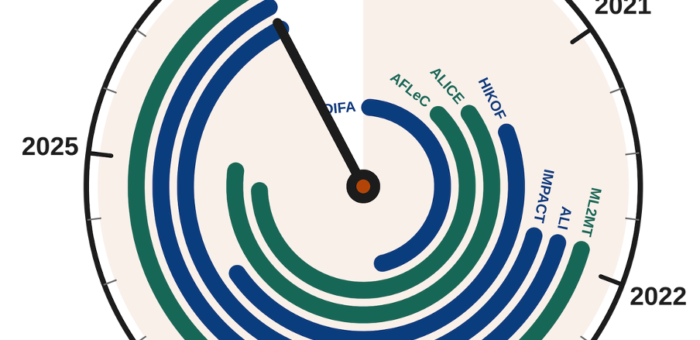
Five years in forty minutes On 7 October 2026, Hendrik Drachsler gave a keynote at the CBIE 2026 conference in Goiana, Brazil, that tried something unusual: time travel. He compressed five years of field research, seven projects and roughly 5,750 students into one forty-minute talk. The question behind the keynote was simple: after five years of developing and testing Highly Informative Learning Analytics (HILA) in real lecture halls, what do we actually know? Not what we hoped HILA might achieve back in 2020, but what five years of our own research and data now tell us. What HILA set out to do HILA starts with a modest observation: most lecture rooms still offer very little personalisation. Learning analytics promised to change that, but its rollout in Europe stalled on four…
Read More
PhD defense: Congratulations, Dr. Manuel Valle Torre!

PhD defense: Congratulations, Dr. Manuel Valle Torre!

Artificial Intelligence, Higher Education, Learning Analytics, PhD defense, School
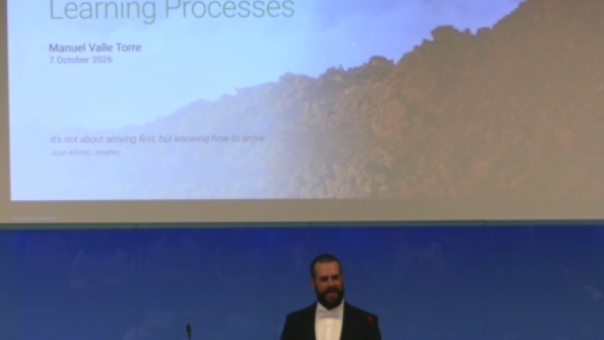
Today, 07.10.2026 at 15:00, Manuel Valle Torre successfully defended his PhD thesis "Sequences in Data to Represent Learning Processes: What have you tried until now?" at Delft University of Technology. Hendrik Drachsler was honoured to take part as an independent member of the doctoral committee. [pdf-embedder url="https://edutec.science/wp-content/uploads/2026/10/Manuel-defense-slides.pdf"] Manuel's thesis starts with a question every programming tutor knows: "What have you tried until now?" Digital learning environments usually assess only the final product, so this question is hard for them to answer. In three phases, Manuel shows how sequences of learner actions can be used to understand learning processes and support them while they happen. He developed ELAT for analysing edX log data, reviewed the field of learning sequence analysis, and studied problem-solving in data science notebooks. He then built JELAI,…
Read More
Invited Talk at the NEES Center, Maceió, Brasil

Invited Talk at the NEES Center, Maceió, Brasil

Higher Education, Invited talk, Keynote, Keynote, Learning Analytics, Learning Design
In August, Hendrik Drachsler was invited to give a talk at the NEES research centre of the Federal University of Alagoas (UFAL) in Maceió, hosted by Prof. Dr Diego Dermeval. The lecture, "Design, Development and Evaluation of Highly Informative Learning Analytics", was organised together with the PPGI graduate programme and drew a full house of 80 participants. Hendrik's argument was straightforward. Most learning analytics is not wrong; it is just not informative enough. Counting clicks and minutes tells a teacher that something happened, not what to do about it. Moving from descriptive to truly informative analytics takes three things: indicators grounded in learning theory, a design process that includes the educators who will use the results, and a governance framework that makes the whole thing defensible. He presented the tools…
Read More
Keynote: From Experiment to Infrastructure: Reflections on AI in Higher Education

Keynote: From Experiment to Infrastructure: Reflections on AI in Higher Education

Academy, Artificial Intelligence, Conference, Higher Education, Keynote, Keynote
Today, Hendrik Drachsler gave a keynote at the VHB annual Conference in Bamberg, speaking to an audience of over 33 AI project leaders from higher education institutions in Germany. The topic was "From Experiment to Infrastructure: Scaling, Evaluation, and Governance of AI Systems in Higher Education," reflecting his thinking on various grassroots projects and how to scale them across the whole university. The gap between performance and learning Hendrik opened with a provocation: Is AI the new calculator? Both technologies automate cognitive processes, both faced early scepticism, and both promised efficiency gains. But the analogy breaks down quickly. A calculator takes over arithmetic, not problem-solving. AI takes over the formulation, analysis, and argument. That is a qualitative difference, and it demands a different institutional / governance response. Mixed results on…
Read More
How AI Systems Impact Mathematics Achievement in Rural Areas

How AI Systems Impact Mathematics Achievement in Rural Areas

Artificial Intelligence, PhD defense, School
On Friday, May 8, 2026, Rashmi Khazanchi successfully defended her doctoral dissertation, "Artificial Intelligence in Education: Impact of AI-Based Systems on Mathematics Achievement," at the Open Universiteit in Heerlen. The defense was supervised by Prof. Dr. Hendrik Drachsler, who holds a guest professorship at the Open Universiteit, alongside co-promotor Prof. Dr. Daniele Di Mitri (German University of Digital Sciences). The Research Question Khazanchi's work addresses a pressing challenge in education: whether AI-based learning systems can help close the mathematics achievement gap for students from socioeconomically disadvantaged backgrounds. Her research focused on students in a rural school district in South Georgia, USA — a setting often characterized by limited resources and a shortage of qualified teachers. What Was Studied The school implemented two AI-based systems to support struggling learners: ALEKS, an…
Read More
New Pub: How Virtual Reality Mental Training Impacts Race Preparation in Recreational Runners

New Pub: How Virtual Reality Mental Training Impacts Race Preparation in Recreational Runners

Augmented Reality, Computational Psychometrics, General education, Journal, New Pub, Publication
Can Virtual Reality Mental Training Help Recreational Runners Race Smarter? We’re glad to announce that our paper has just been published! 🎉 In this post, we share the key ideas and early findings from our newly published study exploring how virtual reality (VR) mental training—grounded in cognitive-behavioral (CB) techniques—may support long-distance recreational runners in adopting race strategies and strengthening motivation within a coaching context. What happens when cognitive-behavioral (CB) techniques like imagery and self-talk meet virtual reality (VR) in a coaching context? An exploratory study of recreational long-distance runners provides intriguing early signals. Why this study matters VR has been used in sports settings to support skill learning and performance, but it’s still relatively uncommon to see VR paired directly with cognitive-behavioral mental training—especially practical tools like imagery and self-talk…
Read More
Its a Wonderful (EduTec) Life: Reflecting 2024.

Its a Wonderful (EduTec) Life: Reflecting 2024.

Alumni, Higher Education, School, Team
Near Christmas time, many people traditionally watch the movie classic “It’s a Wonderful Life” about a man named George, who loses his courage to face life on Christmas night due to a series of difficulties and ends up being saved by an angel who shows him how life would be for the people around him if he had never been born. Poor George has let himself get so caught up in the troubles of everyday life that he has lost sight of all the positive things that he has achieved and the impact he has on those around him. This movie reminds us that we are like George sometimes: we tend to focus on the negative things in daily life and sometimes lose our view of the bigger picture and…
Read More
PhD Defense: A Bridge between Learning Analytics and Learning Design

PhD Defense: A Bridge between Learning Analytics and Learning Design

Book, Event, Higher Education, Learning Analytics, Learning Design, Multimodal Learning Analytics, PhD defense, Publication, School
We warmly congratulate our esteemed associate partner, DR. Marcel Schmitz, on successfully defending his PhD thesis on November 29, 2024. Marcel is a senior lecturer and researcher in Data Intelligence and the Applied Data Science & Artificial Intelligence program at Zuyd University of Applied Sciences. In his dissertation, titled “Towards Learning Analytics-Supported Learning Design”, he focused on how education can be better personalized by incorporating learning analytics already in the design and course planning. His dissertation was supervised by Prof. Dr. Hendrik Drachsler (DIPF | Leibniz Institute & Goethe University Frankfurt), with co-supervisors Prof. Dr. Maren Scheffel (Ruhr University Bochum) and Dr. Roger Bemelmans (Zuyd University of Applied Sciences). Marcel's dissertation provides actionable strategies not only for higher education but also for other educational sectors. His work envisions a future…
Read More
PhD Defense: A Deep Dive into Visual Learning Analytics

PhD Defense: A Deep Dive into Visual Learning Analytics

Award, Higher Education, Learning Analytics, PhD defense, School
On September 13th, Hendrik Drachsler took on the esteemed role of opponent in the PhD defense of Artemis Mohseni at Linnaeus University, Sweden. The defense, which marked a pivotal moment in Artemis’s academic journey, centered around her innovative doctoral thesis titled "Development of Visual Learning Analytics Tools to Explore Performance and Engagement of Students in Primary, Secondary, and Higher Education." The evaluation commission was formed by: Associate professor Olga Viberg, Royal Institute of Technolgy, Sweden Associate professor Linnéa Stenliden, Linköpings University, Sweden Professor Johan Lundin, University of Gothenburg, Sweden Associate professor Fisnik Dalipi, Linnaeus University, Sweden Associate professor Arianit Kurti, Linnaeus University, Sweden It was an exciting defense that showcased Artemis’s research, which focuses on the potential of Visual Learning Analytics (VLA) to enhance teaching and learning by providing actionable…
Read More
HILA goes to school – Keynote at ISDT24, Linnaeus University, Sweden

HILA goes to school – Keynote at ISDT24, Linnaeus University, Sweden

Artificial Intelligence, Conference, Feedback, Keynote, Learning Analytics, School
What happens when Highly-Informative Learning Analytics (HILA) goes to school? That’s exactly what Hendrik Drachsler explored during his keynote at the 3rd International Symposium on Digital Transformation (ISDT24) in Linnaeus University Växjö, Sweden. His talk highlighted the impact of the AFLEK project, a transformative initiative under the HILA research program, which focuses on improving learning outcomes in secondary schools through actionable data and AI-driven tools. The keynote wasn't just about theoretical advances; it presented real-world applications that are actively shaping how secondary education functions today. Through three key publications, Drachsler demonstrated how the integration of Data-Enriched Learning Activities (DeLA), teacher dashboards, and empirical research has paved the way for improved teaching practices and measurable student success. Let’s dive into what happens when HILA meets the classroom. Key Highlights from Hendrik…
Read More