PhD Defense: A Multimodal Immersive Technology Approach in Running: Congratulations, Dr. Cardenas Hernandez!

PhD Defense: A Multimodal Immersive Technology Approach in Running: Congratulations, Dr. Cardenas Hernandez!

Multimodal Learning Analytics, PhD defense
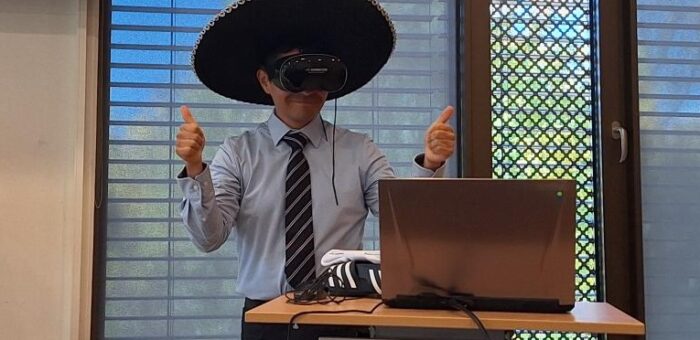
We extend our warmest congratulations to our dear alumni and associate, Fernando Pedro Cardenas Hernandez, on the successful defense of his PhD thesis on Thursday, 29.10.2026!  Great job, Dr. Fernando! We’re so proud of you for achieving this milestone! In his dissertation “Beyond the Physical Toward Mental Training: Investigating a Multimodal Immersive Technology Approach in Running”, Fernando explores the potential of immersive technologies, like Virtual Reality (VR), to promote a holistic approach to learning and improving running skills. His research aims to address the gap in contemporary training practices that often focus on physical and biomechanical analysis while neglecting the cognitive dimensions of performance. [pdf-embedder url="https://edutec.science/wp-content/uploads/2026/10/Slides_Fernando.pdf"]   As a starting point for his research, he consulted experienced running coaches to identify four interdependent aspects of holistic running training: physical, technical,…
Read More
[New Pub] How Do I Say It Best? What Prompt Optimisation Can Reveal About Optimal Prompt Formulation In LLM-based Automated Short Answer Scoring

[New Pub] How Do I Say It Best? What Prompt Optimisation Can Reveal About Optimal Prompt Formulation In LLM-based Automated Short Answer Scoring

New Pub
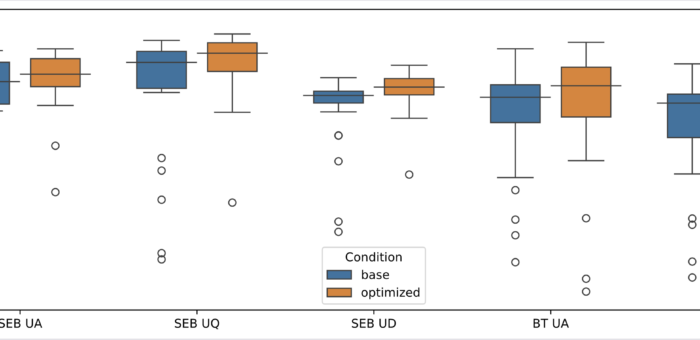
How much does the wording of a prompt matter when AI scores students’ answers? In our paper, we investigated this using three open-weight language models and two English-language short-answer scoring benchmarks. We compared human-written prompts with prompts automatically refined using ProTeGi, which analyses scoring errors and proposes improved instructions. Across 135 paired comparisons, optimisation delivered a median improvement of around two F1 points. Beyond improving performance, it also revealed patterns in effective prompt design: optimised prompts used more words that make logical relationships explicit, such as “if” and “because,” and shorter noun phrases. These features were also associated with better scoring performance, while more directive verbs were associated with poorer results. Our findings suggest that clear logical structure and simpler phrasing are promising principles for prompt design, and that automatic…
Read More
A Warm Welcome to Our Guest Researcher Laís Pisetta van Vossen

A Warm Welcome to Our Guest Researcher Laís Pisetta van Vossen

Team
We are delighted to welcome Laís Pisetta van Vossen as a guest researcher in our team! Laís has recently completed her master’s degree in applied computing at UDESC University in Brazil. During her master’s studies she focused on the analyzation of conceptual map data and developed the concept map tool CoMEA. She has published and contributed to several peer-reviewed papers and conference proceedings papers and has actively participated in recognized international conferences, such as AIED 2024 and ECTEL 2025. She will use her one year stay at DIPF as a research station to further develop her work, integrate it with the ongoing studies in the field and strengthen her research foundation before formally beginning a PhD in Germany. During her stay, she will work closely with the EduTec team, collaborating…
Read More
New Pub: How Students Think About and Act Upon Personalized, Automated Feedback on Transactivity

New Pub: How Students Think About and Act Upon Personalized, Automated Feedback on Transactivity

Computer-supported collaborative learning, Conference, Feedback, Higher Education, Publication
A key factor for success in collaborative learning environments is transactivity. This process, whereby learners engage with and build upon the ideas of others, is crucial for learning outcomes. In today's digital learning environments, AI-powered speech and text analysis can be used to measure the extent to which learners interact with one another. In a recent randomized field study involving 252 student teachers, a research team examined how different forms of automated feedback influence the transactivity in online discussions. The study compared basic feedback (BAF), consisting of general information and a performance summary, with highly informative feedback (HIF), consisting of highly personalized, detailed feedback on various aspects of transavtivity. The results were surprising: Although the participants rated the personalized feedback significantly more positively, it did not lead to any measurable…
Read More
[New Pub] Exploratory Bayesian Multidimensional IRT with Rater Effects for Scoring Generative AI Usage

[New Pub] Exploratory Bayesian Multidimensional IRT with Rater Effects for Scoring Generative AI Usage

Artificial Intelligence, Assessment, Computational Psychometrics, Conference, Critical Online Reasoning, Higher Education, Publication, Research Methods
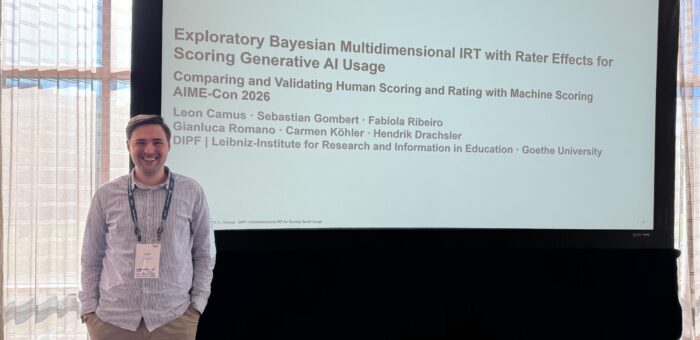
At AIME-Con 2026 (October 5–7, Pittsburgh), Leon Camus presented the paper "Exploratory Bayesian Multidimensional IRT with Rater Effects for Scoring Generative AI Usage". Scoring frameworks usually treat students' AI use as a single scale from little to a lot. This hides the difference between a student who uses a chatbot as a research assistant and one who hands the whole task to it. The paper introduces a multidimensional Bayesian IRT model with rater effects that captures these different usage patterns without predefining which rubric items belong to which dimension. Applied to about 18,000 ratings of 251 German undergraduates working on Critical Online Reasoning tasks, the model identifies three dimensions of AI use: active prompting effort, delegation of substantive content, and AI-delivered citation use. Students working in their own academic domain prompted more,…
Read More
Keynote: 5 years of Highly Informative Learning Analytics

Keynote: 5 years of Highly Informative Learning Analytics

Artificial Intelligence, Conference, Feedback, Higher Education, Keynote, Learning Analytics, Learning Design, Research Methods, School
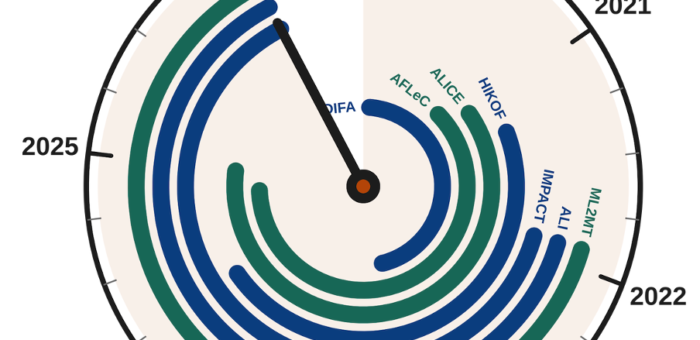
Five years in forty minutes On 7 October 2026, Hendrik Drachsler gave a keynote at the CBIE 2026 conference in Goiana, Brazil, that tried something unusual: time travel. He compressed five years of field research, seven projects and roughly 5,750 students into one forty-minute talk. The question behind the keynote was simple: after five years of developing and testing Highly Informative Learning Analytics (HILA) in real lecture halls, what do we actually know? Not what we hoped HILA might achieve back in 2020, but what five years of our own research and data now tell us. What HILA set out to do HILA starts with a modest observation: most lecture rooms still offer very little personalisation. Learning analytics promised to change that, but its rollout in Europe stalled on four…
Read More
PhD defense: Congratulations, Dr. Manuel Valle Torre!

PhD defense: Congratulations, Dr. Manuel Valle Torre!

Artificial Intelligence, Higher Education, Learning Analytics, PhD defense, School
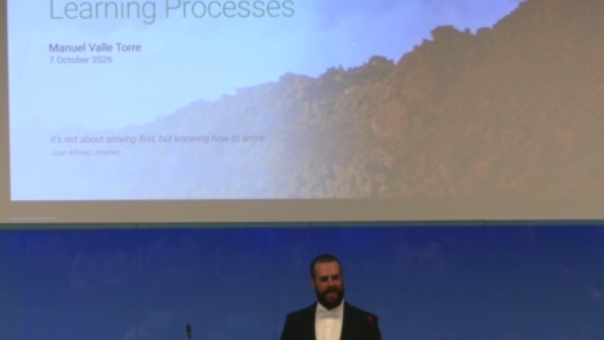
Today, 07.10.2026 at 15:00, Manuel Valle Torre successfully defended his PhD thesis "Sequences in Data to Represent Learning Processes: What have you tried until now?" at Delft University of Technology. Hendrik Drachsler was honoured to take part as an independent member of the doctoral committee. [pdf-embedder url="https://edutec.science/wp-content/uploads/2026/10/Manuel-defense-slides.pdf"] Manuel's thesis starts with a question every programming tutor knows: "What have you tried until now?" Digital learning environments usually assess only the final product, so this question is hard for them to answer. In three phases, Manuel shows how sequences of learner actions can be used to understand learning processes and support them while they happen. He developed ELAT for analysing edX log data, reviewed the field of learning sequence analysis, and studied problem-solving in data science notebooks. He then built JELAI,…
Read More