
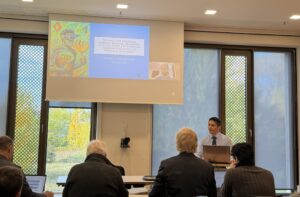
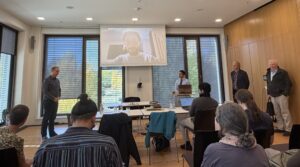
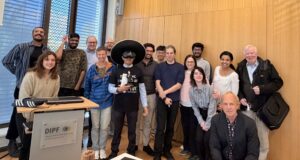
We extend our warmest congratulations to our dear alumni and associate, Fernando Pedro Cardenas Hernandez, on the successful defense of his PhD thesis on Thursday, 29.10.2026! Great job, Dr. Fernando! We’re so proud of you for achieving this milestone!
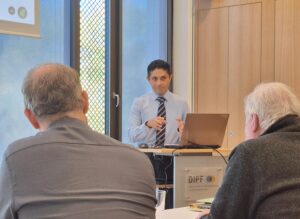
In his dissertation “Beyond the Physical Toward Mental Training: Investigating a Multimodal Immersive Technology Approach in Running”, Fernando explores the potential of immersive technologies, like Virtual Reality (VR), to promote a holistic approach to learning and improving running skills. His research aims to address the gap in contemporary training practices that often focus on physical and biomechanical analysis while neglecting the cognitive dimensions of performance.
As a starting point for his research, he consulted experienced running coaches to identify four interdependent aspects of holistic running training: physical, technical, mental and body awareness. Based on this he developed a Multimodal Learning Experience framework to illustrate how immersive technologies could support all four of these aspects. Of these four aspects, he identified the mental dimension of motivation, self-talk and focus as the one that is most often neglected.

To address this identified gap in mental skill development, he developed a VR-based mental training tool grounded in Cognitive-Behavioral principles. In a feasibility study, the tool let recreational runners rehearse race scenarios, like the start line or the finishing sprint, within an immersive environment filled with virtual competitors. Early testing showed runners embraced the experience and began thinking more strategically.
The VR application was then refined to incorporate additional race segments and a second mental training technique: self-talk. In a follow-up study, participants completed a baseline race, then engaged in structured VR mental training and finally ran a second race. The results showed that participants used the trained drafting technique more strategically and reported an increased application of self-talk and a more deliberate approach to pacing.

The research highlights the potential of VR to bridge the divide between physical and mental training modalities by providing a controlled yet psychologically authentic environment for repeated practice and refinement. This research shows that VR isn’t just for gaming. It is a powerful new approach in athletic training, offering a path toward truly integrated, mind-and-body development by merging coach wisdom with immersive tech to deliver personalized and adaptive pathways for holistic athletic development.
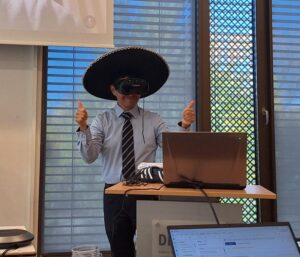
We warmly congratulate Fernando on accomplishing this significant achievement. His contributions have greatly enriched our knowledge and will pave the way for future research in the field of VR and sport education.
We wish you all the best, Dr. Fernando!