

Five years in forty minutes
On 7 October 2026, Hendrik Drachsler gave a keynote at the CBIE 2026 conference in Goiana, Brazil, that tried something unusual: time travel. He compressed five years of field research, seven projects and roughly 5,750 students into one forty-minute talk.
The question behind the keynote was simple: after five years of developing and testing Highly Informative Learning Analytics (HILA) in real lecture halls, what do we actually know? Not what we hoped HILA might achieve back in 2020, but what five years of our own research and data now tell us.
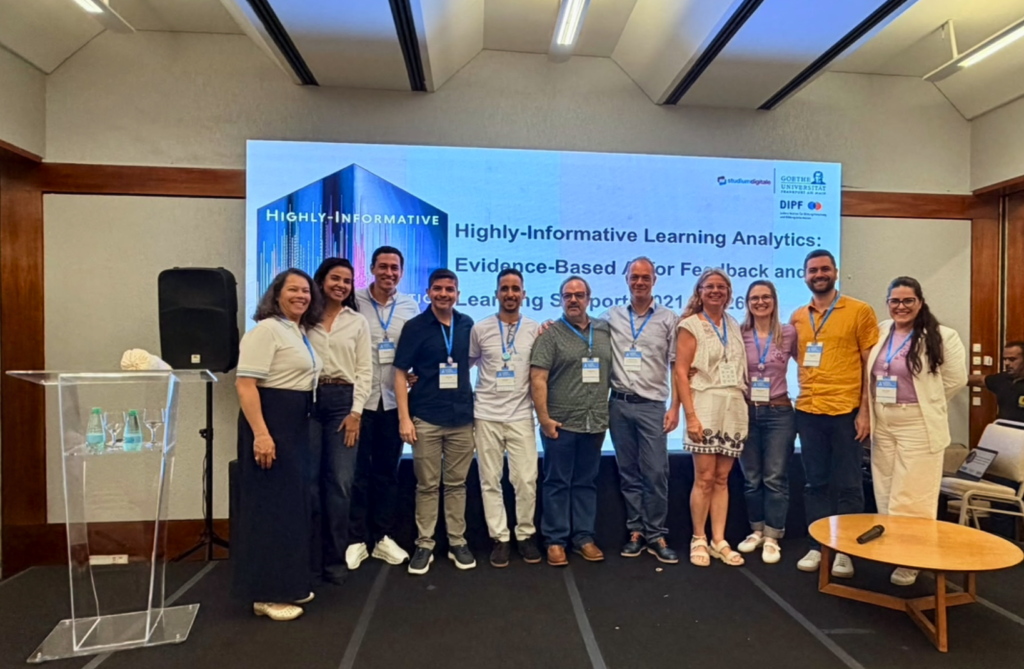 What HILA set out to do
HILA starts with a modest observation: most lecture rooms still offer very little personalisation. Learning analytics promised to change that, but its rollout in Europe stalled on four challenges:
- ethics and privacy,
- weak pedagogical grounding,
- resource demands,
- and engagement and buy-in.
Hendrik chose to focus the team’s work at the micro level of learning, in the actual lecture halls. The team built Data-enriched Learning Activities (DeLAs) for the most common things learners do: reading, writing, modelling and discussing. Each DeLA collects process data and feeds it into highly informative feedback, which goes beyond right or wrong and offers correct solutions, hints for improvement and support for competence development, ideally during the learning process.
The programme is framed as a chain, with one hypothesis per link:
- Capture: DeLAs make learning processes measurable.
- Interpret: AI can reliably assess learning outcomes.
- Feedback: students and teachers value highly informative feedback.
- Impact: the feedback improves learning outcomes and behaviour.
- Personalisation: it works for all learners in the same way.
Seven projects, about 5,750 learners
The evidence comes from seven externally funded projects that ran between 2020 and 2025, four in higher education and three in school. Together, they involved about 5,750 students and pupils in real teaching settings, not in the lab.
Hendrik and his team built one platform that serves both higher education and school, and they used it to standardise their field studies. At the heart of this approach are the DeLAs, which act as measurement instruments: each one collects data for a specific competence goal, such as understanding radiation, the energy transition or mathematical equations. This makes the approach reliable because the same DeLA collects the same kind of evidence across courses, disciplines, and cohorts. It also makes it valid, because the data is tied to the competence itself rather than to clicks or time on task.
The focus is deliberately on the curriculum’s core competences, not on self-regulation or other metacognitive skills that many learning analytics studies target. In this way, HILA concentrates on what learners are expected to master in their subject in the first place.
What the evidence says
The short version: students clearly value highly informative feedback, but learning gains so far appear only when teachers act on the analytics. Hendrik presented how each hypothesis held up.
Mapped onto Kirkpatrick’s four evaluation levels, the picture is honest and a little sobering. Reaction is well evidenced. Learning is mixed. Behaviour change has not yet been shown. Results at programme or institutional level remain open.
For Hendrik, the most important lesson came from H5: “We need better feedback skills, not just better technology.” Feedback literacy, emotions and prior knowledge decide who benefits.
What stays, what changes
According to Hendrik, five years have left the programme with solid foundations: DeLA infrastructure in five projects across school and university, shared datasets and scoring pipelines such as ALICE LP and the BEA 2026 shared task, and a validated instrument for feedback literacy (SFLI).
The findings also show where the programme will adjust:
- Measure what learners do, not only what they think. The next studies will capture behaviour and learning outcomes, not just perceptions.
- Add feed-forward. Students need to see not only where they stand but how to get where they want to be.
- Personalise the feedback itself. Tailor it to feedback literacy, prior knowledge and learner needs.
- Test transfer and fairness. Validate models on new texts, questions and cohorts before they reach classrooms at scale.
- Compare the routes. Test no feedback, automated feedback and teacher mediated feedback side by side, and follow whether effects last.
The next strand is a DeLA model and a systematic review of the team’s own evidence, so that what was learned in seven projects becomes a theory others can build on.
Measure what you value
Drachsler closed the keynote with the sentence that has guided HILA from the start: “Measure what you value; don’t value what you can easily measure.” Five years in, he argued, it still holds, because the data easiest to collect is rarely the data that shows whether someone learned.
He thanked the EduTec team at DIPF, colleagues at Goethe University and studiumdigitale, partners in the Leibniz and BMBF networks, and the many teachers, students and pupils who opened their classrooms to the research.