
New Pub: Towards Collaborative Convergence: Quantifying Collaboration Quality with Automated Co-located Collaboration Analytics

New Pub: Towards Collaborative Convergence: Quantifying Collaboration Quality with Automated Co-located Collaboration Analytics

Conference, Conference, Event, Higher Education, Learning Design, Multimodal Learning Analytics, Publication
Collaboration is one of the four important 21st-century skills. With the pervasive use of sensors, interest on co-located collaboration (CC) has increased lately. Most related literature used the audio modality to detect indicators of collaboration (such as total speaking time and turn taking). CC takes place in physical spaces where group members share their social (i.e., non-verbal audio indicators like speaking time, gestures) and epistemic space (i.e., verbal audio indicators like the content of the conversation). Past literature has mostly focused on the social space to detect the quality of collaboration. In this study, we focus on both social and epistemic space with an emphasis on the epistemic space to understand different evolving collaboration patterns and collaborative convergence and quantify collaboration quality. We conduct field trials by collecting audio recordings…
Read More
New Pub: Measuring Productivity in CSCL groups

New Pub: Measuring Productivity in CSCL groups

Assessment, Conference, Empirical Study, Higher Education, Learning Design, Publication
Computer-supported collaborative learning (CSCL) is a common pedagogical approach, in which groups of students work together digitally to engage in learning activities, solve problems, or create a shared artefact. CSCL is further interesting from a research standpoint, because different disciplines want to understand the processes and circumstances from which productive social interaction in online groups emerge to facilitate learning among group members. As such, group productivity is a central outcome to be considered in CSCL research. At the same time, the current literature does not provide a valid and reliable self-report instrument to measure group productivity.   [caption id="attachment_3914" align="alignleft" width="325"] Wright Map[/caption] [caption id="attachment_3915" align="alignleft" width="323"] Category probability curves with six (top) versus 5 (bottom) rating scale steps[/caption]                      …
Read More
Webinar: What happens when students get to choose indicators on customisable dashboards?

Webinar: What happens when students get to choose indicators on customisable dashboards?

Conference, Higher Education, Learning Analytics, Webinar
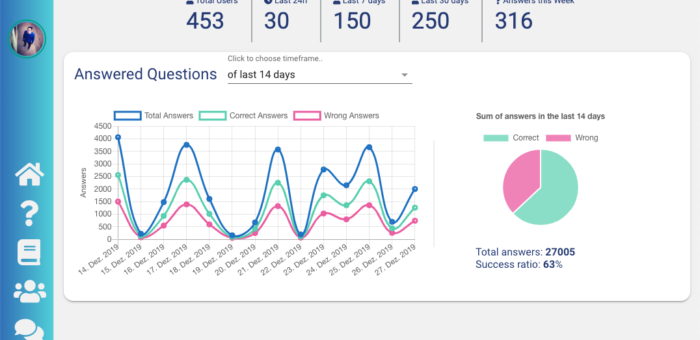
Learning analytics dashboards (LADs) are essentially feedback tools for learners. However, until recently, learners rarely have had a role in designing LADs, especially in deciding the information they would like to receive through such devices. Although learners might not always know what they need to self-manage their learning, we need to understand what type of feedback information and dashboard features they are likely to engage with and if, when, and how they use dashboards. To explore how LADs can better meet the needs of learners, we have embarked on two sets of studies aiming to understand students' information needs. In the first set of studies, we developed a customisable LAD for Coursera MOOCs on which learners can set goals and choose feedback indicators to monitor. We then analysed the learners'…
Read More
New Pub: Designing the Learning Analytics Cockpit – A Dashboard that Enables Interventions

New Pub: Designing the Learning Analytics Cockpit – A Dashboard that Enables Interventions

Conference, Conference, Higher Education, Learning Analytics, Publication
This paper presents results from our design and evaluation studies of the Learning Analytics Cockpit (LA Cockpit) for a quiz app, which aims to provide lecturers with important information about students’ knowledge levels. We define a LA Cockpit as a tool for instructors that enables them to steer students’ learning process by providing a LA Dashboard which visualizes students’ learning indicators and an intervention feature enabling instructors to give feedback based on students’ knowledge levels. To address the needs of lecturers we applied the Double Diamond (DD) design process model which consists of four stages: discover, define, develop & refine. Following the DD process, we first conducted a qualitative study by interviewing four lecturers and student teachers to discover their needs. Results from the interviews allowed us to define requirements…
Read More
New Pub: EDMEDIA 2021 Conference Paper

New Pub: EDMEDIA 2021 Conference Paper

Conference, Learning Analytics, Publication
Our conference article has been published at EDMEDIA 2021 relating to the preliminary findings based on a systematic review on teaching analytics (see abstract below) and we are currently working on extending these findings for a journal article…… Title: Utilising learning analytics for teaching success Authors: Jane Yau & Dirk Ifenthaler Abstract: Learning analytics are utilized to support learners’ educational needs as well as to enhance their study success, for example, via the use of real-time prompts, motivational dashboards, appropriate learning interventions, which have been shown to increase students’ academic performance as well as their course retention rates. The combination of student, learning and curriculum profiles consisting of static and dynamic parameters enable analytics to be computed and academic interventions to take place. In this paper, we present the results of a systematic…
Read More
New Pub: Analysis of the “D’oh!” moments.

New Pub: Analysis of the “D’oh!” moments.

Artificial Intelligence, Conference, Conference, Further Education, Higher Education, Lifelong Learning, Multimodal Learning Analytics, Publication
“Soul and body, I suggest reacting sympathetically upon each other. A change in the state of the soul produces a change in the shape of the body and conversely, a change in the shape of the body produces a change in the state of the soul.” To test this hypothesis proposed by Aristotle, our bachelor student Tetiana Buraha investigated the physiology of students performing task-switching exercises. The physiological data were collected using an Empatica E4 band. The performances of the students were compared against the physiological data using descriptive statistics and machine learning techniques. The analysis of Tetiana enabled the identification of interesting correlations between galvanic skin response and performance, and models to predict performance based on the physiological data. Results of her excellent thesis were published and presented at…
Read More
New Pub: Get your Back Straight!

New Pub: Get your Back Straight!

Conference, Conference, Game, Lifelong Learning, Multimodal Learning Analytics, Publication
“Mens sana in corpore sano” is a phrase that we all have heard multiple times in our life. We know all the positive effects of Sports and Exercise. However, let’s face it! Physical activity is not always fun and when doing it incorrectly without any guidance or feedback it is difficult to see improvements or even worse, we can face the risk of injury. To address these issues Anna Meik for her bachelor thesis developed the Pilates correction App. An application designed to support the practice of the “Kneeling Arm and Leg Reach” Pilates exercise in a gamified way, where the user helps a virtual rocket to reach high scores through the stability of their lower backs. Meik, A., Schneider, J., & Schiffner, D. (2021). Get your back straight! Learn…
Read More
#Hackathon Game Design – Agenda (29.-31.10.2021)

#Hackathon Game Design – Agenda (29.-31.10.2021)

Augmented Reality, Conference, Empirical Study, Higher Education, Project, Team, Workshop
Agenda HackathonHier findet ihr die Agenda für das #Hackathon Wochenende zu AR-Game Design. Alle wichtigen Links & Infos für das gesamte Wochenende werden Euch vorher per Mail zugeschickt. Tag 1 - Freitag 29.10.2021 (15:00-20:00 Uhr) 15 Uhr Beginn des Hackathons Willkommen Dana Kube & EduTec TeamLecture: Was ist eure Challenge? Wie nutzt man AR Games im MINT-Schulunterricht? (Ala Al-saleh)Tutorial: Spiele & Entwicklungsumgebung (Onur Karademir)16 Uhr Klärung Aufgabenstellung & Team-Sessions bis 20 Uhr 20 Uhr Drinks & Games Socializing Event bis ca. 22 Uhr Tag 2 - Samstag 30.10.2021 (ab 10:00 Uhr) 10 Uhr Welcome back - Dana Kube & EduTec Team10:15 Uhr Team-Sessions, 15:00 Uhr kurzes Feedback im Plenum ab 15 Uhr (bis open End) Fertigstellung der Spiele-(Ideen) & Vorbereitung der Präsentation Tag 3 - Sonntag 31.10.2021 (10:00-12:30 Uhr) 10 Uhr Welcome back - Dana…
Read More
New MMLA Pub: Get your back straight! Learn Pilates with the Pilates Correction App

New MMLA Pub: Get your back straight! Learn Pilates with the Pilates Correction App

Conference, General education, Multimodal Learning Analytics, Open access, Publication
Currently, a vast number of the population faces several barriers like the lack of motivation and guidance that impede them from practicing physical activities. Thus, we developed the Pilates Correction Game (PCG), a gamified application designed to support learners with the practice of Pilates. The PCG is composed of two applications: a smartphone application that tracks the learner’s back posture and a PC game that steers a rocket and calculates a score based on the smartphone's information. In this paper, we present a user experience evaluation on the PCG. Our results show that PCG was positively perceived by participants and in most cases helped them to improve their posture while doing the Pilates exercise. Furthermore, it is also motivating them to continue with the training. Reference: Meik, A., Schneider, J.,…
Read More
New Pub: The Design Cycle for Education (DC4E)

New Pub: The Design Cycle for Education (DC4E)

Conference, General education, Learning Design, Open access, Publication
The need for more and better online and blended education has lately become even more apparent. Many educational institutions had to pivot to emergency remote teaching. While online learning in itself is nothing new, the scope, suddenness and speed of this shift certainly was. However, courses and modules created for face-to-face settings, cannot simply be turned into blended or fully online ones easily. Learning design models can provide guidelines and guidance. Often, however, they are not constructed in a comprehensive way and are mainly conceptual. We thus created a procedural design model enriched with templates, tools, information and design examples to specifically support and facilitate the (re)design of blended and online learning and teaching and to thus provide quality education: the Design Cycle for Education (DC4E). Reference: Scheffel, M., Schmitz,…
Read More