Paper and presentation about the topic of detecting disengaged reading at LAK23

Paper and presentation about the topic of detecting disengaged reading at LAK23

Conference, Conference, Event, Higher Education, Publication, Research topic, Self-Regulation, Target group
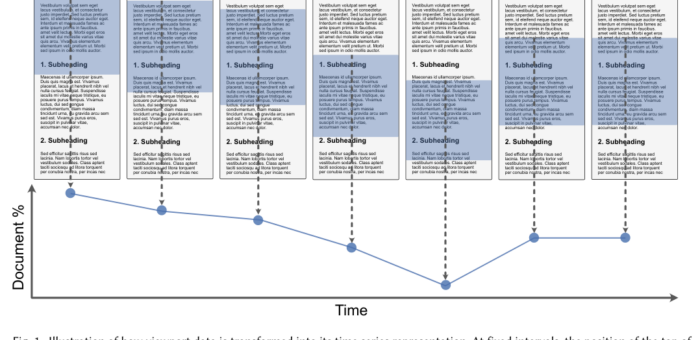
At the recent Learning Analytics and Knowledge Conference (LAK23), Daniel Biedermann presented his paper "Detecting the Disengaged Reader - Using Scrolling Data to Predict Disengagement during Reading," to shed light on the potential for early detection of disengagement in readers. The paper presents a unique method for early disengagement detection that relies solely on the classification of scrolling data. By transforming scrolling data into a time series representation, each point of the series represents the vertical position of the viewport in the text document. Time series classification algorithms are then used to evaluate the data.The results were promising, with the method able to classify disengagement early with up to 70% accuracy. However, the study also observed differences in performance depending on which texts were included in the training dataset. Biedermann…
Read More
Best Short Paper Award Nomination @LAK23

Best Short Paper Award Nomination @LAK23

Award, Conference, Conference, Higher Education, Learning Analytics
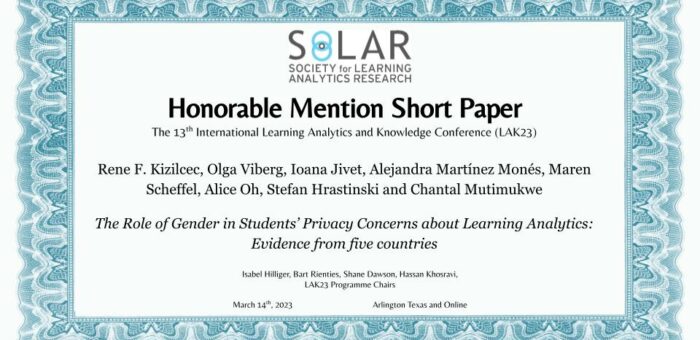
The protection of students’ privacy in learning analytics (LA) applications is critical for cultivating trust and effective implementations of LA in educational environments around the world. However, students’ privacy concerns and how they may vary along demographic dimensions that historically influence these concerns have yet to be studied in higher education. Gender differences, in particular, are known to be associated with people's information privacy concerns, including in educational settings. Building on an empirically validated model and survey instrument for student privacy concerns, their antecedents and their behavioral outcomes, we investigate the presence of gender differences in students’ privacy concerns about LA. We conducted a survey study of students in higher education across five countries (N = 762): Germany, South Korea, Spain, Sweden and the United States. Using multiple regression analysis,…
Read More
Presentation: Atezaz participated in the ICDLE conference and presented a new publication

Presentation: Atezaz participated in the ICDLE conference and presented a new publication

Artificial Intelligence, Conference, Conference, Feedback, Further Education, Learning Analytics, Lifelong Learning, Open access, Publication, Self-Regulation
Our paper titled "Caught in the Lifelong Learning Maze: Helping People with Learning Analytics and Chatbots to Find Personal Career Paths" was accepted at the 13th International Conference on Distance Learning and Education (ICDLE 2022) held at the University of Barcelona, Spain. Atezaz Ahmad participated in the conference and presented their publication. The article will be published (open access) in the International Journal of Information and Education Technology. Abstract: Current lifelong learning platforms offer users a query option to select a wide variety of courses. However, finding a suitable course among the seemingly endless catalogs of options presented by the platforms is not straightforward. We argue that digital counseling can enhance this process. In this paper, we present a set of three formative studies where we explored the main aspects…
Read More
New Pub: Superpowers in the Classroom: Hyperchalk is an Online Whiteboard for Learning Analytics Data Collection

New Pub: Superpowers in the Classroom: Hyperchalk is an Online Whiteboard for Learning Analytics Data Collection

Computer-supported collaborative learning, Conference, Conference, Event, Further Education, General education, Higher Education, Learning Analytics, Lifelong Learning, Publication, School, Technical paper
A new system demonstration paper authored by Lukas Menzel, Sebastian Gombert, Daniele Di Mitri and Henrik Drachsler has been released as part of the ECTEL 2022 proceedings. In this paper, we present Hyperchalk, a self-hosted collaborative online whiteboard software. Similar to commercial solutions like Miro or Flinga, this software provides users with collaborative boards which they can use to draw, write or sketch together. However, unlike commercial solutions, Hyperchalk allows for collecting rich log data, which can be used to study the behaviour of its users and to allow Learning Analytics and studies on computer-supported collaborative learning. Moreover, Hyperchalk comes with a built-in replay mode which allows watching how users behave in its spaces. It supports the LTI1.3 standard, which enables seamless integration with learning management systems such as Moodle,…
Read More
Gender & STEM Conference 2022 – EduTec Member Dana Kube presented her Ph.D. work

Gender & STEM Conference 2022 – EduTec Member Dana Kube presented her Ph.D. work

Assessment, Conference, Conference, Digitalisation, Event, Higher Education, Journal, Learning Design, Publication, Workshop
A few impressions: After a two-year break, scholars can finally meet again for a personal exchange at the "Gender & STEM Conference". I was able to meet so many exciting people and studies, and I think that we German universities have benefited especially from the intersectional and feminist perspectives from the USA, Canada and the Netherlands: How do transgender students experience support in Computer Science? What can universities do to keep students of colour and especially women* of colour longer in STEM programmes? Stop fixing Women* in STEM was the tenor, fix the System: I go back to Frankfurt with a lot of smart approaches on the institutional and pedagogical level and a lot of encouraging feedback on my PhD thesis on Gender in STEM/Technology. My personal highlight was meeting…
Read More
New Pub: What Indicators Can I Serve You with? An Evaluation of a Research-Driven Learning Analytics Indicator Repository

New Pub: What Indicators Can I Serve You with? An Evaluation of a Research-Driven Learning Analytics Indicator Repository

Conference, Digitalisation, Learning Analytics, Learning Design, Publication
In recent years, Learning Analytics (LA) has become a very heterogeneous research field due to the diversity in the data generated by the Learning Management Systems (LMS) as well as the researchers in a variety of disciplines, who analyze this data from a range of perspectives. In this paper, we present the evaluation of a LA tool that helps course designers, teachers, students and educational researchers to make informed decisions about the selection of learning activities and LA indicators for their course design or LA dashboard. The aim of this paper is to present Open Learning Analytics Indicator Repository (OpenLAIR) and provide a first evaluation with key stakeholders (N=41). Moreover, it presents the results of the prevalence of indicators that have been used over the past ten years in LA.…
Read More
New Pub: Analytics for Supporting Teaching Success in Higher Education: A Systematic Review

New Pub: Analytics for Supporting Teaching Success in Higher Education: A Systematic Review

Conference, Higher Education, Learning Analytics, Literature review, Publication
Learning analytics are utilized to support learners’ educational needs as well as to enhance their study success, for example, via the use of real-time prompts, motivational dashboards, and appropriate learning interventions, which have been shown to increase students’ academic performance as well as their course retention rates. Yet, the perspective of higher education teachers in utilizing analytics to help analyze, reflect on, and improve their teaching design prior to delivery as well as to monitor and measure how the students engaged withtheir learning processes has been less recognized. In this paper, we present the results of a systematic review conducted from higher education teachers’ perspective concerning how analytics can be deployed to adapt the curriculum to suit better students’ educational needs in order to increase their study success. Thirty-five key…
Read More
New Pub: Towards Collaborative Convergence: Quantifying Collaboration Quality with Automated Co-located Collaboration Analytics

New Pub: Towards Collaborative Convergence: Quantifying Collaboration Quality with Automated Co-located Collaboration Analytics

Conference, Conference, Event, Higher Education, Learning Design, Multimodal Learning Analytics, Publication
Collaboration is one of the four important 21st-century skills. With the pervasive use of sensors, interest on co-located collaboration (CC) has increased lately. Most related literature used the audio modality to detect indicators of collaboration (such as total speaking time and turn taking). CC takes place in physical spaces where group members share their social (i.e., non-verbal audio indicators like speaking time, gestures) and epistemic space (i.e., verbal audio indicators like the content of the conversation). Past literature has mostly focused on the social space to detect the quality of collaboration. In this study, we focus on both social and epistemic space with an emphasis on the epistemic space to understand different evolving collaboration patterns and collaborative convergence and quantify collaboration quality. We conduct field trials by collecting audio recordings…
Read More
New Pub: Measuring Productivity in CSCL groups

New Pub: Measuring Productivity in CSCL groups

Assessment, Conference, Empirical Study, Higher Education, Learning Design, Publication
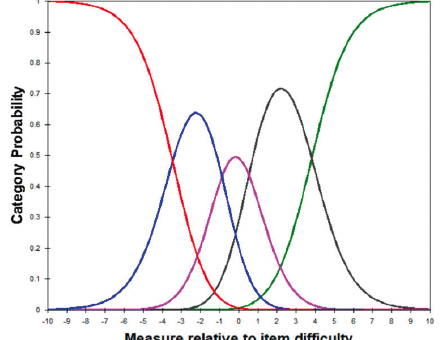
Computer-supported collaborative learning (CSCL) is a common pedagogical approach, in which groups of students work together digitally to engage in learning activities, solve problems, or create a shared artefact. CSCL is further interesting from a research standpoint, because different disciplines want to understand the processes and circumstances from which productive social interaction in online groups emerge to facilitate learning among group members. As such, group productivity is a central outcome to be considered in CSCL research. At the same time, the current literature does not provide a valid and reliable self-report instrument to measure group productivity.   [caption id="attachment_3914" align="alignleft" width="325"] Wright Map[/caption] [caption id="attachment_3915" align="alignleft" width="323"] Category probability curves with six (top) versus 5 (bottom) rating scale steps[/caption]                      …
Read More
Webinar: What happens when students get to choose indicators on customisable dashboards?

Webinar: What happens when students get to choose indicators on customisable dashboards?

Conference, Higher Education, Learning Analytics, Webinar
Learning analytics dashboards (LADs) are essentially feedback tools for learners. However, until recently, learners rarely have had a role in designing LADs, especially in deciding the information they would like to receive through such devices. Although learners might not always know what they need to self-manage their learning, we need to understand what type of feedback information and dashboard features they are likely to engage with and if, when, and how they use dashboards. To explore how LADs can better meet the needs of learners, we have embarked on two sets of studies aiming to understand students' information needs. In the first set of studies, we developed a customisable LAD for Coursera MOOCs on which learners can set goals and choose feedback indicators to monitor. We then analysed the learners'…
Read More