Kickoff Meeting: MILKY-PSY – Multimodal Immersive Learning with Artificial Intelligence for Psychomotor Skills

Kickoff Meeting: MILKY-PSY – Multimodal Immersive Learning with Artificial Intelligence for Psychomotor Skills

Digitalisation, Higher Education, Multimodal Learning Analytics, Project
Those who want to learn a sport train new psychomotor skills. Until now, this has required role models such as teachers on site who explain, demonstrate and assess certain processes. A consortium around the Cologne Game Lab of the TH Köln is developing a learning environment with artificial intelligence (AI) to support the training process as part of the joint research project MILKI-PSY.   Wer eine Sportart erlernen will, trainiert neue psychomotorische Fähigkeiten. Bislang werden dafür Vorbilder wie Lehrerinnen und Lehrer vor Ort benötigt, die bestimmte Abläufe erklären, zeigen und beurteilen. Ein Konsortium um das Cologne Game Lab der TH Köln entwickelt im Rahmen des Verbundforschungsprojekts MILKI-PSY eine Lernumgebung mit künstlicher Intelligenz (KI), die den Trainingsprozess unterstützen soll. Künstlerische, sportliche und handwerkliche Tätigkeiten erfordern psychomotorische Fähigkeiten, bei denen körperliche Bewegungen mit…

Read More
KI@Schule – Virtueller Expert*innen-Workshop

KI@Schule – Virtueller Expert*innen-Workshop

Artificial Intelligence, Learning Analytics, Project, School, Workshop
Prof. Dr. Hendrik Drachsler wurde von der Deutschen Telekom-Stiftung mit 15 weiteren Expert*innen zum virtuellen Workshop „KI@Schule – Zwischen Wunsch und Wahrscheinlichkeit“ am 25. Februar 2021 eingeladen, um die Befunde der Trend- und Zukunftsstudie „Künstliche Intelligenz in der schulischen Bildung“ zu diskutieren. Prof. Dr Hendrik Drachsler and 15 other experts were invited by the Deutsche Telekom Foundation to the virtual workshop "KI@Schule - Zwischen Wunsch und Wahrscheinlichkeit" on 25 February 2021 to discuss the findings of the trend and future study "Künstliche Intelligenz in der schulischen Bildung".
Read More
Künstliche Intelligenz füttert natürliche Gehirne

Künstliche Intelligenz füttert natürliche Gehirne

Artificial Intelligence, General education, Press
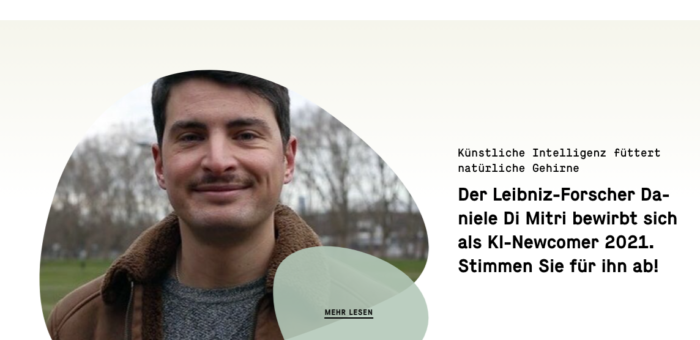
Interview originally published on leibniz-gemeinschaft.de  written by Christoph Herbort-von Loeper. **  English version below ** Künstliche Intelligenz füttert natürliche Gehirne Der Leibniz-Forscher Daniele Di Mitri bewirbt sich als KI-Newcomer 2021. Stimmen Sie für ihn ab! 17.02.2021 Wie kann Künstliche Intelligenz in der Bildung eingesetzt werden? Damit beschäftigt sich Daniele Di Mitri am DIPF | Leibniz-Institut für Bildungsforschung und Bildungsinformation. Ein Gespräch über Lernen auf Distanz, digitalen Unterricht über Videokonferenzen hinaus und warum wir Künstliche Intelligenz nicht nur dafür nutzen sollten, uns die passenden Filme oder Werbung anzeigen zu lassen. Daniele Di Mitri bewirbt sich aktuell als KI-Newcomer 2021, einer Aktion der Gesellschaft für Informatik. Hier können Sie bis zum 7. März für ihn abstimmen: http://kicamp.org/en/ai-newcomers Digitalisierung in der Bildung ist gerade in der Pandemie ein heiß diskutiertes Thema. Dabei geht…
Read More
NEW Newsletter and Update on AR4STEAM

NEW Newsletter and Update on AR4STEAM

Augmented Reality, Digitalisation, Project, Publication, Report, School
AR4STE(A)M Newsletter 2 We have the pleasure to update you by this Newsletter with advance made in our project, which is designed to provide attractive means and ways  to improve current technological methods, encouraging STEAM education. Joining us, you will find in our publications a lot of useful information, tips and new opportunities for modern and effective teaching.
Read More
New Pub: A four-country cross-case analysis of academic staff expectations about learning analytics in higher education

New Pub: A four-country cross-case analysis of academic staff expectations about learning analytics in higher education

Higher Education, Journal, Learning Analytics, Open access, Publication
The purpose of this paper is to explore the expectations of academic staff to learning analytics services from an ideal as well as a realistic perspective. This mixed-method study focused on a cross-case analysis of staff from Higher Education Institutions from four European universities (Spain, Estonia, Netherlands, UK). While there are some differences between the countries as well as between ideal and predicted expectations, the overarching results indicate that academic staff sees learning analytics as a tool to understand the learning activities and possibility to provide feedback for the students and adapt the curriculum to meet learners' needs. However, one of the findings from the study across cases is the generally consistently low expectation and desire for academic staff to be obligated to act based on data that shows students…
Read More
New Pub: Understanding Graph Problem solving with the use of Eye-tracking and Epistemic Network Analysis

New Pub: Understanding Graph Problem solving with the use of Eye-tracking and Epistemic Network Analysis

Journal, Multimodal Learning Analytics, Open access, Publication, School
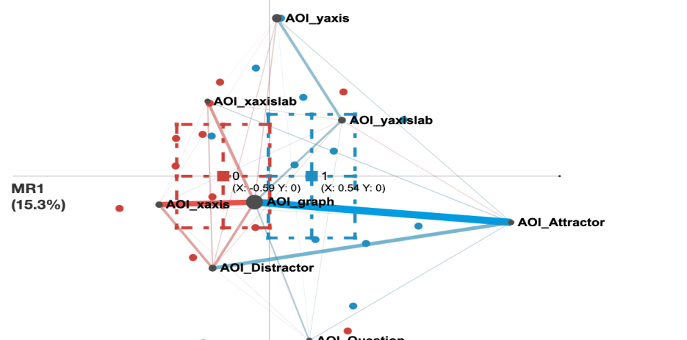
Epistemic Network Analyses of Economics Students’ Graph Understanding: An Eye-Tracking Study Learning to solve graph tasks is one of the key prerequisites of acquiring domain-specific knowledge in most study domains. Analyses of graph understanding often use eye-tracking and focus on analyzing how much time students spend gazing at particular areas of a graph—Areas of Interest (AOIs). To gain a deeper insight into students’ task-solving process, we argue that the gaze shifts between students’ fixations on different AOIs (so-termed transitions) also need to be included in holistic analyses of graph understanding that consider the importance of transitions for the task-solving process. Thus, we introduced Epistemic Network Analysis (ENA) as a novel approach to analyze eye-tracking data of 23 university students who solved eight multiple-choice graph tasks in physics and economics. ENA…
Read More
New Pub: Learning Analytics Cookbook – How to Support Learning Processes Through Data Analytics and Visualization

New Pub: Learning Analytics Cookbook – How to Support Learning Processes Through Data Analytics and Visualization

General education, Learning Analytics, Publication
This book offers an introduction and hands-on examples that demonstrate how Learning Analytics (LA) can be used to enhance digital learning, teaching and training at various levels. While the majority of existing literature on the subject focuses on its application at large corporations, this book develops and showcases approaches that bring LA closer to smaller organizations, and to educational institutions that lack sufficient resources to implement a full-fledged LA infrastructure. In closing, the book introduces a set of software tools for data analytics and visualization, and explains how they can be employed in several LA scenarios. Reference: Jaakonmäki, R., vom Brocke, J., Dietze, S., Drachsler, H., Fortenbacher, A., Helbig, R., Kickmeier-Rust, M., Marenzi, I., Fernández, Á.S., Yun, H. (2020). Learning Analytics Cookbook - How to Support Learning Processes Through Data Analytics and Visualization. SpringerBriefs in Business Process Management, XI, 93, DOI: 10.1007/978-3-030-43377-2,…
Read More