GREAT project posters presentations at IEEE Games, Entertainment & Media Conference

Conference
Jane Yau was at the IEEE Games, Entertainment and Media Conference last week in Torino, Italy (5-7 June), and shared GREAT project findings - 📢Co-designing Pilot Games with Citizens and Policy Stakeholders to Increase Climate Action 📌This paper presents an initial report on the codesign processes between researchers and policy stakeholders in the GREAT (Games Realising Effective and Affective Transformation) project applied in the context of the climate emergency. 📢 Exploring the Concept of Mini Data Sprints as a Methodology to Assess Data Validity and Stimulate Climate Conversation 📌 The authors present two studies that have deployed mini data sprints (MDS). The MDS approach uses interactive data applications and visualisations to provoke citizens’ feelings, knowledge, and perspectives towards the climate conversation and presented data. These studies highlight how the MDS…
Read More
New Pub: Emotional and motivational effects of automated and personalized feedback

New Pub: Emotional and motivational effects of automated and personalized feedback

Computer-supported collaborative learning, Empirical Study, Feedback, Higher Education, Journal, Learning Analytics, New Pub, Open access
With increasingly large student numbers, providing personalized teacher feedback becomes untenable. On the other hand, providing students feedback about their work is an integral part of ensuring student support throughout their learning trajectory. Fortunately, Learning Analytics now makes it feasible to automatically deploy feedback to many students at once. However, the design of effective feedback still remains an area of investigation Joshua Weidlich, Aron Fink, Ioana Jivet, Jane Yau, Tornike Giorgashvili, Hendrik Drachsler, and Andreas Frey's recently published paper in the Journal of Computer-Assisted Learning focused on one key design feature: the reference frame. Any feedback content must be formulated in reference to some performance level, be it the average of the student group (social comparison), the desired performance level (criterion-referenced comparison), or past performance. A longstanding literature on this…
Read More
Last HIKOF-Beiratsmeeting & Project Wrap-Up 2021-2024

Last HIKOF-Beiratsmeeting & Project Wrap-Up 2021-2024

Project
On 13.5.24, HIKOF project members – Hendrik, Jane, Josh, Sebastian G. (DIPF), Andreas Frey, Aron Fink (GU Psychology), Tornike and Thorsten (GU Studiumdigitale) met members of the HIKOF-Beirat online to share final project results. The project has been running for the past three years from May 2021 and has officially ended in May 2024. In 2022, we completed our pilot study, and in 2023, our evaluation study with ca. 1000 students in a Teacher Education course at Goethe University, where we collected (with students' consent) information relating to their motivation and emotions before and after they had completed their assignments. We constructed some machine learning models for automatically assessing the assignments in order to reduce lecturers' workload. Finally, we provided highly-informative competence driven feedback to students and also collected their…
Read More
GREAT project presentation at the Int. Conf. of Young Scientists 2024

GREAT project presentation at the Int. Conf. of Young Scientists 2024

Conference
From 7-10 May 2024, Jane Yau was at the International Conference of Young Scientists, held in conjunction with the Global Young Academy Annual Conference. This year's theme was "Transformative and inclusive science for a sustainable future" and was held at the National Academy of Sciences, Engineering and Medicine in Washington D. C. Jane presented the GREAT project, which was recorded and live-streamed (the recording will be available shortly). Positive and enthusiastic feedback was received relating to how the project can align with the United Nations Climate Promise Plan to reduce global carbon emissions by 1.5 degrees by 2025. The project is currently undertaking a number of case studies and by the end of the year, there will be lots of detailed results relating to how games can be used effectively…
Read More
New Pub: I don’t have time! But keep me in the loop: Co-designing requirements for a learning analytics cockpit with teachers

New Pub: I don’t have time! But keep me in the loop: Co-designing requirements for a learning analytics cockpit with teachers

Empirical Study, Learning Analytics, New Pub, Research Methods, School
Teacher dashboards can help secondary school teachers manage online learning activities and inform instructional decisions by visualising information about class learning. However, when designing teacher dashboards, it is not trivial to choose which information to display, because not all of the vast amount of information retrieved from digital learning environments is useful for teaching. Information elicited from formative assessment (FA), though, is a strong predictor for student performance and can be a useful data source for effective teacher dashboards. Especially in the secondary education context, FA and feedback on FA, have been extensively studied and shown to positively affect student learning outcomes. Moreover, secondary teachers struggle to make sense of the information displayed in dashboards and decide on pedagogical actions, such as providing feedback to students. Objectives: To facilitate the…
Read More
New Pub: Students Want to Experiment While Teachers Care More About Assessment! Exploring How Novices and Experts Engage in Course Design

New Pub: Students Want to Experiment While Teachers Care More About Assessment! Exploring How Novices and Experts Engage in Course Design

Computer-supported collaborative learning, Conference, Conference, Higher Education, Learning Analytics, Learning Design, New Pub, Open access, Open science, Publication, Technical paper
Abstract: Learning Design (LD) is the strategic orchestration of educational components to create a rewarding experience for students and educators. Adapting it to real-world scenarios with evolving technologies, like learning analytics (LA), adds complexity but offers the potential for enhanced learning outcomes and engagement. Prior research highlights the growing importance of LA in informing LD decisions. The FoLA2 method offers a collaborative approach to course design considering LA implications. This study pursues two primary objectives. Firstly, to enhance the FoLA2 method by granting course designers access to the Open Learning Analytics Indicator Repository (OpenLAIR) that facilitates visual connections between LD pedagogies, LDLA activities, LA indicators and their metrics. Secondly, to explore how novice and expert groups utilize the FoLA2 methodology to design a course in Technology Enhanced Learning. The findings…
Read More
Atezaz’s Conference Paper Presentation at CSEDU in Angers, France

Atezaz’s Conference Paper Presentation at CSEDU in Angers, France

Conference, Conference, Event, Learning Analytics, Learning Design, Publication
Atezaz shared insights from their paper titled "Students Want to Experiment While Teachers Care More About Assessment! Exploring How Novices and Experts Engage in Course Design" at the CSEDU 2024 conference in Angers, France, delving into its implications and findings. Additionally, this paper received a nomination in the Best Student Paper category.
Read More
GREAT project presentation at World Forum Women in Science – Theme “Science for the SDGs”

GREAT project presentation at World Forum Women in Science – Theme “Science for the SDGs”

Event, Invited talk
On 15 April, GREAT project manager Dr. Jane Yau had the pleasure of moderating the session Technology, Sustainability and Industry with Prof. Nova Ahmed at the World Forum Women in Science - Theme: Science for the SDGs (https://women-in-science-without-borders.network/world-forum-women-in-science-2024/).  The session included a number of initiatives of empowering women and underrepresented groups to take on science activities and careers to advance the SDGs. Jane also shared the GREAT project findings in this session with a talk “Gaming for Change: Leveraging digital games to address climate change”, based on the GREAT project methodology and first case study findings!  The session was free to attend and was live-streamed on Facebook. The video recording will be available shortly.Jane will also be in Rome, Italy, on 19 April to attend the in-person Networking Event as…
Read More
New Publication: Addressing gender in STEM classrooms: The impact of gender bias on women scientists’ experiences in higher education careers in Germany

New Publication: Addressing gender in STEM classrooms: The impact of gender bias on women scientists’ experiences in higher education careers in Germany

New Pub
 In an expert study conducted in Germany, Dana Kube and her research team delve into the complex dynamics of gender bias within STEM (Science, Technology, Engineering, and Mathematics) classrooms. The study, aimed at understanding the role gender plays in shaping the experiences of women scientists in higher education, sheds light on the challenges they face and proposes strategies for fostering gender inclusivity in STEM classrooms. The primary objective of the study was two-fold: first, to comprehensively examine the influence of gender and gender bias in STEM environments within higher education institutions, and second, to identify potential areas where Computer-Supported Collaborative Learning (CSCL) pedagogical interventions could mitigate these biases among students and teachers in German STEM departments. Employing the innovative group concept mapping method, the research team collaborated with women participants…
Read More
Personalizing running training with immersive technologies using a multimodal framework

Personalizing running training with immersive technologies using a multimodal framework

Journal, New Pub
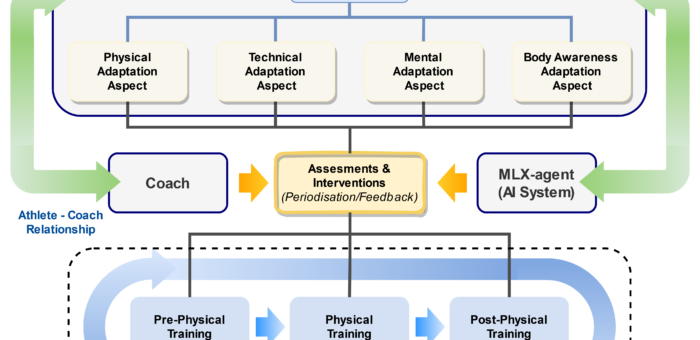
To improve performance and prevent injuries, running training needs proper personalized supervision and planning. This study examines the factors that influence running training programs, and the benefits and challenges of personalized plans. It also investigates how multimodal, immersive and artificial intelligence (AI) technologies can improve personalized training. We did an exploratory sequential mixed research with running coaches. We analyzed the data and found relevant factors of the training process. We recognized four key aspects for running training: physical, technical, mental and body awareness. We used these aspects to create a framework that proposes multimodal, immersive and AI technologies to help personalized running training. It also lets coaches guide their athletes on each aspect personally. The framework aims to personalize the training by showing how coaches and multimodal learning experience agents…
Read More