
New MMLA Pub: Get your back straight! Learn Pilates with the Pilates Correction App

New MMLA Pub: Get your back straight! Learn Pilates with the Pilates Correction App

Conference, General education, Multimodal Learning Analytics, Open access, Publication
Currently, a vast number of the population faces several barriers like the lack of motivation and guidance that impede them from practicing physical activities. Thus, we developed the Pilates Correction Game (PCG), a gamified application designed to support learners with the practice of Pilates. The PCG is composed of two applications: a smartphone application that tracks the learner’s back posture and a PC game that steers a rocket and calculates a score based on the smartphone's information. In this paper, we present a user experience evaluation on the PCG. Our results show that PCG was positively perceived by participants and in most cases helped them to improve their posture while doing the Pilates exercise. Furthermore, it is also motivating them to continue with the training. Reference: Meik, A., Schneider, J.,…
Read More
New Pub: The Design Cycle for Education (DC4E)

New Pub: The Design Cycle for Education (DC4E)

Conference, General education, Learning Design, Open access, Publication
The need for more and better online and blended education has lately become even more apparent. Many educational institutions had to pivot to emergency remote teaching. While online learning in itself is nothing new, the scope, suddenness and speed of this shift certainly was. However, courses and modules created for face-to-face settings, cannot simply be turned into blended or fully online ones easily. Learning design models can provide guidelines and guidance. Often, however, they are not constructed in a comprehensive way and are mainly conceptual. We thus created a procedural design model enriched with templates, tools, information and design examples to specifically support and facilitate the (re)design of blended and online learning and teaching and to thus provide quality education: the Design Cycle for Education (DC4E). Reference: Scheffel, M., Schmitz,…
Read More
New Pub: Digital self-control interventions for distracting media multitasking – A systematic review

New Pub: Digital self-control interventions for distracting media multitasking – A systematic review

General education, Journal, Open access, Publication
Digital distractions can interfere with goal attainment and lead to undesirable habits that are hard to get red rid of. Various digital self-control interventions promise support to alleviate the negative impact of digital distractions. These interventions use different approaches, such as the blocking of apps and websites, goal setting, or visualizations of device usage statistics. While many apps and browser extensions make use of these features, little is known about their effectiveness. This systematic review synthesizes the current research to provide insights into the effectiveness of the different kinds of interventions. The interventions showed varying degrees of effectiveness, and especially interventions that relied purely on increasing the participants' awareness were barely effective. For those interventions that sanctioned the use of distractions, the current literature indicates that the sanctions have to…
Read More
New Pub: A short history, emerging challenges and co-operation structures for Artificial Intelligence in education

New Pub: A short history, emerging challenges and co-operation structures for Artificial Intelligence in education

Artificial Intelligence, Higher Education, Journal, Lifelong Learning, Publication, School
To accompany the special issue in Artificial Intelligence and Education, this article presents a short history of research in the field and summarises emerging challenges. We highlight key paradigm shifts that are becoming possible but also the need to pay attention to theory, implementation and pedagogy while adhering to ethical principles. We conclude by drawing attention to international co-operation structures in the field that can support the interdiscipniary perspectives and methods required to undertake research in the area. Reference: Mavrikis, M., Cukurova, M.,  Di Mitri, D., Schneider, J., & Drachsler, H. (2021). A short history, emerging challenges and co-operation structures for Artificial Intelligence in education. Bildung und Erziehung 2021 74:3, 249-263. https://doi.org/10.13109/buer.2021.74.3.249.
Read More
Ioana Jivet joins the team

Ioana Jivet joins the team

Artificial Intelligence, Higher Education, Learning Analytics, Learning Design, Team
Ioana Jivet is Associate Researcher at EduTech group at DIPF Leibniz Institute for Research and Information in Education. Ioana obtained her Masters degree in Computer Science in 2016 from the TU Delft and then pursued a PhD at the Open University of the Netherlands which she obtained in March 2021 Cum Laude. Her research focused on designing learner-facing learning analytics dashboards that foster the development of self-regulated learning skills. Over the past years, she has contributed to Competen-SEA, a capacity building project in South-East Asia around MOOCs, and SHEILA, a research project that investigated the adoption of learning analytics in European higher education institutions and built a policy development framework for HEIs to facilitate adoption. At the moment, Ioana is serving on the Executive Committee of the Society of Learning…
Read More
QE Webinar series moderated by DIPF

QE Webinar series moderated by DIPF

Further Education, General education, Higher Education, Lifelong Learning, School, Webinar
The monthly QE Webinar Series showcases emerging research and exciting new developments in Quantitative Ethnography. These one-hour events begin with a 30-minute presentation by scholars from the QE community, followed by 30 minutes of moderated discussion. Attendance is free and open to anyone who is interested! The DIPF is currently moderating a series of webinars of the Quantified Ethnography (QE) community as pre-events to the QE conference taking place in October. So far we have been discussing the following topics and the recording can be watched back: Putting the E in QE: How Quantitative Ethnography can Enrich Qualitative Analyses Yotam Hod University of Haifa QE Data ChallengeField Report: Reflecting on the benefits of multidisciplinary research teams Daniel Spikol University of Copenhagen, DK Barbara Wasson University of Bergen, Norway Stefano Schiavetto…

Read More
Gianluca Romano joins the team

Gianluca Romano joins the team

Higher Education, Multimodal Learning Analytics, Team
Starting July 2021, Gianluca Romano joins the team as a doctoral researcher. He holds a Master's as well as a Bachelor's degree in Computer Science from the Goethe University Frankfurt. He finished his study with a thesis on an Intelligent Tutoring System for dancing which was also published in an online journal. Further, he has experience as an AI Engineer and currently is also employed as a Machine Learning Engineer.
Read More
New Pub: Literature Review on Co-Located Collaboration Modeling Using Multimodal Learning Analytics—Can We Go the Whole Nine Yards?

New Pub: Literature Review on Co-Located Collaboration Modeling Using Multimodal Learning Analytics—Can We Go the Whole Nine Yards?

General education, Journal, Literature review, Multimodal Learning Analytics, Open access, Publication
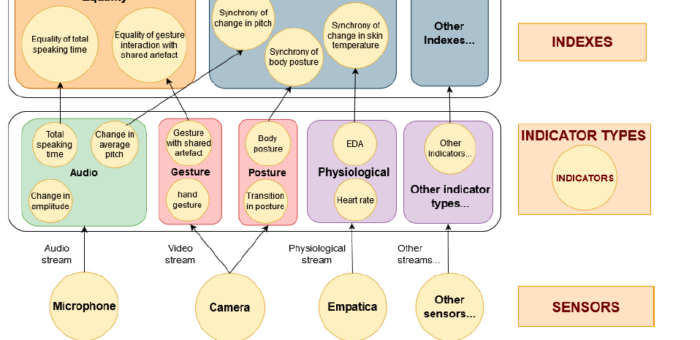
Collaboration is one of the important 21st-century skills. It can take place in remote or co-located settings. Co-located collaboration (CC) is a very complex process that involves subtle human interactions that can be described with indicators like eye gaze, speaking time, pitch, and social skills from different modalities. With the advent of sensors, multimodal learning analytics has gained momentum to detect CC quality. Indicators (or low-level events) can be used to detect CC quality with the help of measurable markers (i.e., indexes composed of one or more indicators) which give the high-level collaboration process definition. However, this understanding is incomplete without considering the scenarios (such as problem solving or meetings) of CC. The scenario of CC affects the set of indicators considered: for instance, in collaborative programming, grabbing the mouse…
Read More
New Pub: Are We There Yet? – A Systematic Literature Review on Chatbots in Education

New Pub: Are We There Yet? – A Systematic Literature Review on Chatbots in Education

Artificial Intelligence, General education, Journal, Learning Analytics, Literature review, Open access, Publication
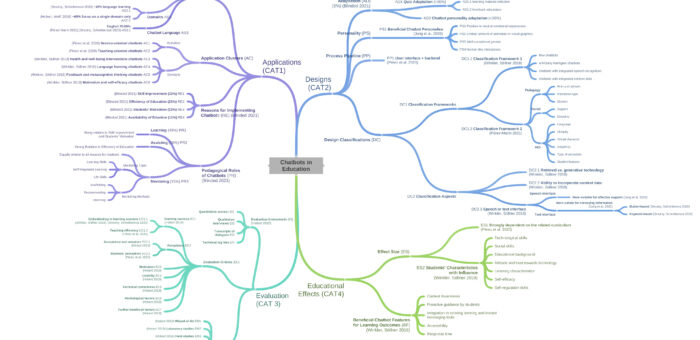
Are We There Yet? - A Systematic Literature Review on Chatbots in Education Chatbots are a promising technology with the potential to enhance workplaces and everyday life. In terms of scalability and accessibility, they also offer unique possibilities as communication and information tools for digital learning. In this work, we present a systematic literature review investigating the areas of education where chatbots have already been applied, explore the pedagogical roles of chatbots, the use of chatbots for mentoring purposes, and their potential to personalize education. We conducted a preliminary analysis of 2,678 publications to perform this literature review, which allowed us to identify 74 relevant publications for chatbots’ application in education. Through this, we address five research questions that, together, allow us to explore the current state-of-the-art of this educational…
Read More
SoLAR webinar on: Investigating persistent and new challenges of learning analytics

SoLAR webinar on: Investigating persistent and new challenges of learning analytics

Artificial Intelligence, Computational Psychometrics, Higher Education, Keynote, Learning Analytics, Learning Design, Multimodal Learning Analytics, School, Workshop
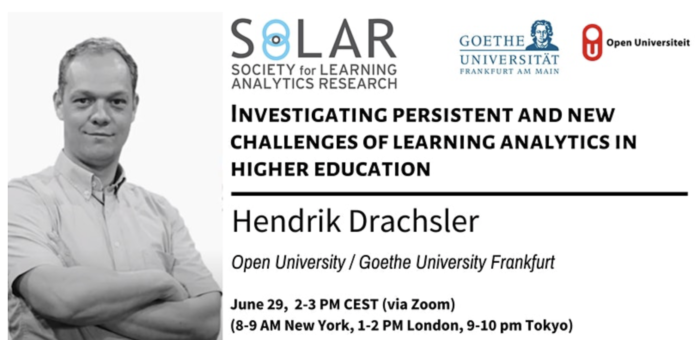
On 29 June 2021, Hendrik Drachsler gave an invited webinar for the SoLAR webinar channel where he reflected the process of applying learning analytics solutions within higher education settings and schools, its implications, and the critical lessons learned in the Trusted Learning Research Program. The talk focused on the experience of edutec.science research collective consisting of researchers from the Netherlands and Germany that contribute to the Trusted Learning Analytics (TLA) research program. The TLA program aims to provide actionable and supportive feedback to students and stands in the tradition of human-centred learning analytics concepts.  It, therefore, applies sensor technology to support psychomotor as well as web technology to support meta-cognitive and collaborative learning skills with high-informative feedback methods. Hendrik applies validated measurement instruments from the field of psychometric and investigates…
Read More