HIKOF-DL – 4th Committee Meeting with Industry Members

HIKOF-DL – 4th Committee Meeting with Industry Members

Event, Transfer Activity
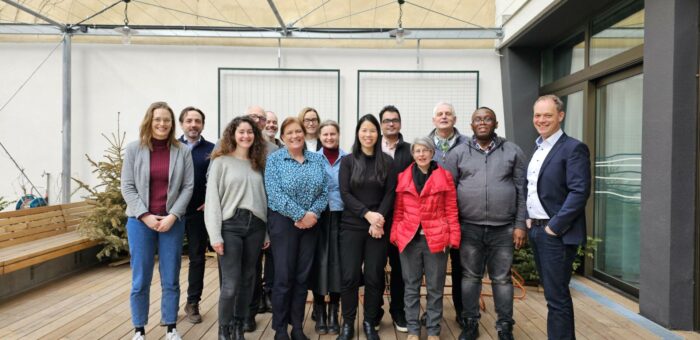
The fourth Committee meeting with industry members of the research project "HIKOF-DL" took place on March 31, 2023. HIKOF-DL is a project funded by the Hessen Ministerium für Digital Strategie und Entwicklung, which aims to provide high-informative feedback for a large number of university students, and automatic assessment, in order to reduce the lecturers' workload. The meeting yielded exciting results and discussions, showcasing the progress and potential of this innovative study. The meeting kicked off with an introduction by Prof. Dr. Hendrik Drachsler, who emphasized the significance of artificial intelligence (AI) in education. Dr. Joshua Weidlich, a key researcher in the project, then presented the research design of the study. The study population was divided into an experimental group and a control group to investigate two aspects: how students respond…
Read More
Paper and presentation about the topic of detecting disengaged reading at LAK23

Paper and presentation about the topic of detecting disengaged reading at LAK23

Conference, Conference, Event, Higher Education, Publication, Research topic, Self-Regulation, Target group
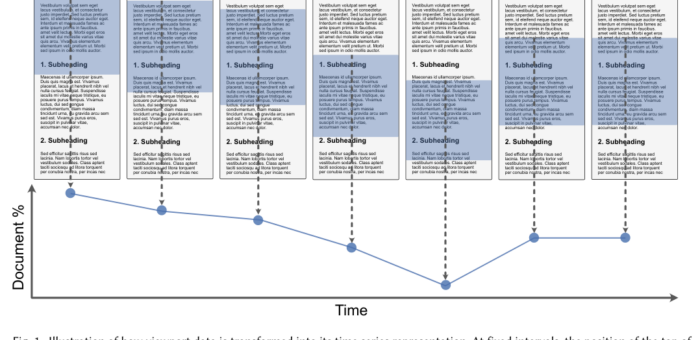
At the recent Learning Analytics and Knowledge Conference (LAK23), Daniel Biedermann presented his paper "Detecting the Disengaged Reader - Using Scrolling Data to Predict Disengagement during Reading," to shed light on the potential for early detection of disengagement in readers. The paper presents a unique method for early disengagement detection that relies solely on the classification of scrolling data. By transforming scrolling data into a time series representation, each point of the series represents the vertical position of the viewport in the text document. Time series classification algorithms are then used to evaluate the data.The results were promising, with the method able to classify disengagement early with up to 70% accuracy. However, the study also observed differences in performance depending on which texts were included in the training dataset. Biedermann…
Read More
Reelection in the Executive Committee of SoLAR

Reelection in the Executive Committee of SoLAR

Learning Analytics, Team
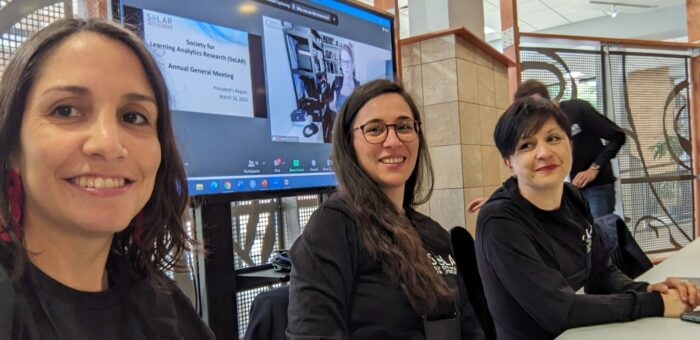
Ioana Jivet has been reelected to the Executive Committee of the Society for Learning Analytics Research (SoLAR) for another mandate of two years 2023-2025. The Executive committee governs the society's work and meets regularly to decide on matters of policy, general business, the tabling of reports from any Committee and any other matter that requires the Executive’s decision-making powers. The Society for Learning Analytics Research (SoLAR) is an inter-disciplinary network of leading international researchers who are exploring the role and impact of analytics on teaching, learning, training and development. SoLAR has been active in organizing the International Conference on Learning Analytics & Knowledge (LAK) and the Learning Analytics Summer Institute (LASI), launching multiple initiatives to support collaborative and open research around learning analytics, promoting the publication and dissemination of learning analytics research, and advising and…
Read More
Highly Informative LA Workshop at LAK23

Highly Informative LA Workshop at LAK23

Conference, Higher Education, Learning Analytics, Learning Design, Workshop
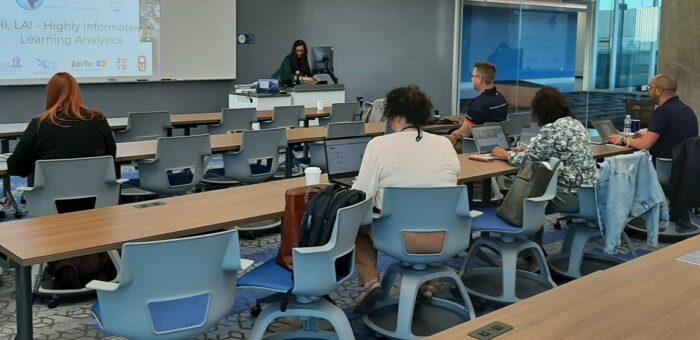
On the 13th of March 2023, as part of the LAK23 conference, five EduTec team members (Daniele Di Mitri, Ioana Jivet, Sebastian Gombert, Atezaz Ahmad and Hendrik Drachsler) organised a full-day workshop on Highly Informative Learning Analytics with Marcel Schmitz from Zuyd University of Applied Sciences, The Netherlands. In this workshop, we investigated the concept of highly informative learning analytics and proposed a methodology for designing an environment that delivers highly informative learning analytics. The workshop is intended as a hands-on, interactive session that allows participants to test the methodology’s potential in a realistic use case. The proposed approach is based on the four-stage process of the Design Cycle for Education (DC4E). We exemplify practical tools that were designed in-house for each stage, including a tool to support teachers while…
Read More
Best Short Paper Award Nomination @LAK23

Best Short Paper Award Nomination @LAK23

Award, Conference, Conference, Higher Education, Learning Analytics
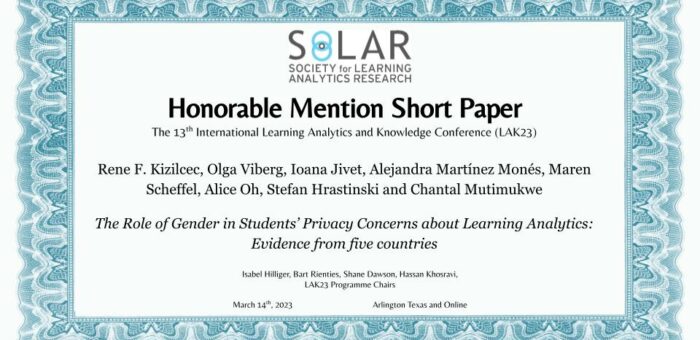
The protection of students’ privacy in learning analytics (LA) applications is critical for cultivating trust and effective implementations of LA in educational environments around the world. However, students’ privacy concerns and how they may vary along demographic dimensions that historically influence these concerns have yet to be studied in higher education. Gender differences, in particular, are known to be associated with people's information privacy concerns, including in educational settings. Building on an empirically validated model and survey instrument for student privacy concerns, their antecedents and their behavioral outcomes, we investigate the presence of gender differences in students’ privacy concerns about LA. We conducted a survey study of students in higher education across five countries (N = 762): Germany, South Korea, Spain, Sweden and the United States. Using multiple regression analysis,…
Read More
New Pub: Caught in the Lifelong Learning Maze: Helping People with Learning Analytics and Chatbots to Find Personal Career Paths

New Pub: Caught in the Lifelong Learning Maze: Helping People with Learning Analytics and Chatbots to Find Personal Career Paths

Higher Education, Learning Analytics
Abstract—Current lifelong learning platforms offer users a query option to select a wide variety of courses. However, finding a suitable course among the seemingly endless catalogs of options presented by the platforms is not straightforward. We argue that digital counseling can enhance this process. In this paper, we present a set of three formative studies where we explored the main aspects that can provide the counseling needed. The methods comprise an analysis of user profile characteristics and learning analytics indicators (e.g., learning progress/self-regulation) by means of an expert workshop, evaluating the feasibility of current technologies (e.g., natural language processing) for automatically assessing users' competencies, and a survey on the use of Chatbots as the interaction interface between the users and the lifelong learning portals. The analysis resulted in the extraction…
Read More
GREAT Project kick-off on 1-2 March

GREAT Project kick-off on 1-2 March

Citizens science, Game, Project, Project meeting
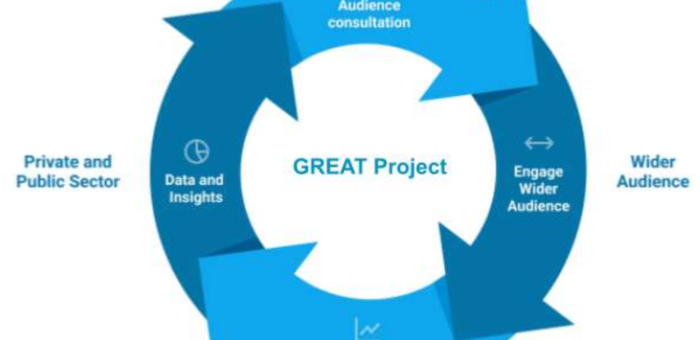
A fruitful and successful kick-off meeting for the GREAT project (Games Realising Effective and Affective Transformation, co-funded by EU and UKRI) with all consortium partners was held on 1-2 March. DIPF project members (Hendrik, Jane, Dana) hosted the 2-day kick-off meeting, which covered all work package activities for the coming 12 months. The project uses games to engage citizens and collect anonymised data regarding climate crisis attitudes and opinions. These are then anonymously analysed and sent to policy-makers, with the aim of influencing them to make even better climate emergency policies more suited to citizens' needs. Two different types of games will be tested: (1.) With simple quiz games on mobile phones - this can reach high numbers of users and thus large data volumes can be generated. The games will…
Read More
Book Chapter – A Trusted Learning Analytics Dashboard for Displaying OER

Book Chapter – A Trusted Learning Analytics Dashboard for Displaying OER

Book, Book chapter, Learning Analytics, Open access, Project, Report
Abstract Learning Analytics (LA) consists of miscellaneous steps that include data harvesting, storing, cleaning, anonymisation, mining, analysis, and visualisation so that the vast amount of educational data is comprehensible and ethically utilisable by educators or instructors to obtain the advantages and benefits that LA can bring to the educational scene. These include the potential to increase learning experiences and reduce dropout rates. In this chapter, we shed light on OER repositories, LA, and LA dashboards and present an implementation of a research-driven LA dashboard for displaying OER and their repositories that allows the visualisation of educational data in an understandable way for both educators and learners. Moreover, we present an LA dashboard for displaying OER that shows information about the existing German OER repositories as part of our EduArc project…
Read More
HIKOF – Evaluation Study Completed

HIKOF – Evaluation Study Completed

Artificial Intelligence, Assessment, Feedback, Learning Analytics, Project
In HIKOF (highly informative feedback for digital learning) project, the evaluation study has been successfully completed, where feedback was provided for about 1000 students in a Teacher Education Course (from Psychology department). Students' feedback on the feedback that was given to them was also collected to determine how comprehensive our feedback was, if it motivated them, and was helpful for them, and enhanced their learning progress. Specifically, the evaluation study focuses on the use of machine learning for  the creation of personalized feedback that is both formative and summative. Data from a pilot study serves as a starting point for the evaluation to further optimize the AI technology for generating feedback. The evaluation study aims to investigate the effect of Highly Informative Automated Feedback (HIAF) on student performance and perception…
Read More
Project kick-off: Games Realising Effective and Affective Transformation (GREAT)

Project kick-off: Games Realising Effective and Affective Transformation (GREAT)

Citizens science, General education, Open science, Project, Project meeting
Using computer games to improve climate protection A new European Union-funded project involving scientific and private-sector partner organizations is investigating how computer games can be used to improve climate protection. The aim is to raise awareness among citizens of the relevant challenges and to provide policymakers with information on how to align climate protection even more closely with the needs of society. The international project consortium is coordinated by the DIPF | Leibniz Institute for Research and Information in Education. "Digital games are becoming increasingly popular. We want to combine this potential with citizen science methods and use it for a central policy field," explains Dr. Jane Yau, a member of the project management team at DIPF together with Dana Kube and Nina Seidenberg. On the one hand, the games…
Read More