News

New Pub: Meaningful Feedback from Wearable Sensor Data to Train Psychomotor Skill

New Pub: Meaningful Feedback from Wearable Sensor Data to Train Psychomotor Skill

Workshop
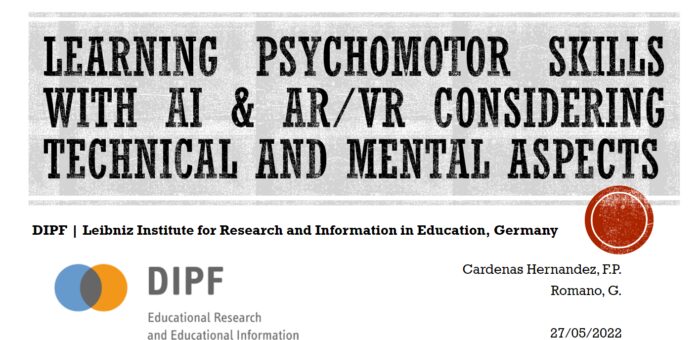
A new workshop paper was presented at the MILeS 2022 workshop written by Gianluca Romano entitled: Meaningful Feedback from Wearable Sensor Data to Train Psychomotor Skill. The MILeS 2022 – Multimodal Immersive Learning Systems workshop took place on the 13th of September at EC-TEL 2022 conference taking place in Toulouse, France. The paper will appear in the CEUR proceedings. Abstract. Learning psycho-motor skills requires feedback for improvement and give insight on performance. However, providing feedback is not trivial. Every learner is different and the same feedback might not work for everyone. The workshop aims to make participants aware of the problematic transition from analyzed wearable sensor data to meaningful feedback. Thus, the participants will get more familiar with wearable sensor data and directly experience how learners might want to receive feedback that they deem…

Read More
DGHD Nachwuchspreis for Joshua Weidlich

DGHD Nachwuchspreis for Joshua Weidlich

Award, Conference, Higher Education, PhD defense
At this year's DGHD2022 in Paderborn, the German Society for Higher Education Pedagogy (Deutsche Gesellschaft für Hochschuldidaktik: DGHD) awarded Dr. Joshua Weidlich for his dissertation on the topic of social presence in online distance education. Supervised by Prof. Dr. Theo Bastiaens, he conducted his dissertation at FernUniversität in Hagen, the largest distance education provider in Germany. The jury commended the scientific merits of advancing this line of research while also providing ample practical implications for higher education teaching. The dissertation is available online here and further information about the award will be published here.
Read More
New Pub: FoLA2 — A Method for Co-creating Learning Analytics–Supported Learning Design

New Pub: FoLA2 — A Method for Co-creating Learning Analytics–Supported Learning Design

Further Education, General education, Higher Education, Journal, Learning Analytics, Learning Design, Open access, Publication, School
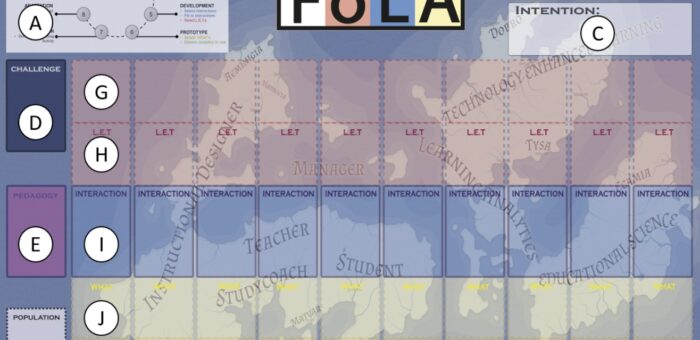
Finally, we have published an article about the FOLA2 method that we have used for over two years frequently to design Learning Analytics supported Learning Designs with teachers of various backgrounds. Learning activities are at the core of every educational design effort. Designing learning activities is a process that benefits from reflecting on previous runs of those activities. One way to measure the behaviour and effects of design choices is to use learning analytics (LA). The challenge, however, lies in the unavailability of an easy-to-use, LA-supported learning design (LD) method. We established a method—the Fellowship of Learning Activities and Analytics (FoLA2)—reinforced by a gameboard and cards to provide structure and inspiration. The method enables several participants with different roles to interact with a set of card decks to create an…
Read More
New Pub: Tools Designed to Support Self-Regulated Learning in Online Learning Environments: A Systematic Review

New Pub: Tools Designed to Support Self-Regulated Learning in Online Learning Environments: A Systematic Review

Higher Education, Journal, Learning Analytics, Self-Regulation
Self-regulated learning (SRL) is a crucial higher-order skill required by learners of the 21st century, who will need to become lifelong learners to adapt to the continually changing environments. Literature provides examples of tools for scaffolding SRL in online environments. In this study, we provide the state-of-the-art concerning tools that support SRL in terms of theoretical models underpinning development, supported SRL processes, tool functionalities, used data and visualizations. We reviewed 42 articles published between 2008 and 2020, including information from 25 tools designed to support SRL. Our findings indicate that (1) many of the studies do not explicitly specify the SRL theoretical model used to guide the design process of the tool; (2) goal setting, monitoring, and self-evaluation are the most prevalent SRL processes supported through functionalities such as content…
Read More
New Pub: Toward learning progression analytics — Developing learning environments for the automated analysis of learning using evidence-centred design

New Pub: Toward learning progression analytics — Developing learning environments for the automated analysis of learning using evidence-centred design

Computational Psychometrics, Journal, Learning Analytics, Learning Design, Open access, Project, Publication, School
[caption id="attachment_4319" align="alignright" width="450"] A procedure for developing digital learning environments that allow for the automated assessment of learning.[/caption] National educational standards stress the importance of science and mathematics learning for today’s students. However, across disciplines, students frequently struggle to meet learning goals about core concepts like energy. Digital learning environments enhanced with artificial intelligence hold the promise to address this issue by providing individualized instruction and support for students at scale. Scaffolding and feedback, for example, are both most effective when tailored to students’ needs. Providing individualized instruction requires continuous assessment of students’ individual knowledge, abilities, and skills in a way that is meaningful for providing tailored support and planning further instruction. While continuously assessing individual students’ science and mathematics learning is challenging, intelligent tutoring systems show that it…
Read More
New Pub: Gendered differences versus doing gender: a systematic review on the role of gender in CSCL

New Pub: Gendered differences versus doing gender: a systematic review on the role of gender in CSCL

Gender, Higher Education, Journal, Literature review, Meta-study, Open access, Publication, Special Issue, Team
How has CSCL research been treating the topic of Gender? Our systematic review on this topic is now published in Unterrichtswissenschaft and available online here. Gender equity in education is an essential UN sustainable development goal. However, it is unclear what aspects of gender are important to consider in regard to research outcomes as well as how findings can be interpreted in the context of gender stereotypes and bias. This lack of clarity is particularly salient in the STEM field. Computer-supported collaborative learning (CSCL) is a group learning method where learners work together on group tasks that aim at the sharing and co-construction of knowledge. Aside from the cognitive learning gains, the literature reports that CSCL can bring social and psychological benefits, such as fostering positive mutual relationships and increased understanding of equity and…
Read More
EARLI EFG Grant awarded

EARLI EFG Grant awarded

Award
The European Association for Research on Learning and Instruction (EARLI) offers an Emerging Field Group (EFG) funding scheme. The goal of the EFG initiative is to support the development of a research group focused on exploratory, innovative, and risk-taking research. EARLI supports the EFG over the course of a two-year period. See the following video for a short intro about EFG funding: [embed]https://youtu.be/P3ErXQdLU2U[/embed] This year, the EARLI EFG committee awarded funding to the "Social- and Telepresence in Online Social Learning" emerging field group, which consists of Emmy Vrieling Teunter (Open University, Netherlands), Kamakshi Rajagopal (KU Leuven, Belgium), Karel Kreijns (Open University, Netherlands), Maartje Henderikx (Open University, Netherlands), Derya Orhan Göksün (Adiyaman University, Turkey), and Joshua Weidlich (DIPF, Germany). The group will explore how perceptions of social-and telepresence are fostered in…
Read More
New Pub: Connecting the dots – A literature review on learning analytics indicators from a learning design perspective

New Pub: Connecting the dots – A literature review on learning analytics indicators from a learning design perspective

Empirical Study, Higher Education, Journal, Learning Analytics, Learning Design, Lifelong Learning, Literature review, Open access, Publication, Self-Regulation, Special Issue, Target group
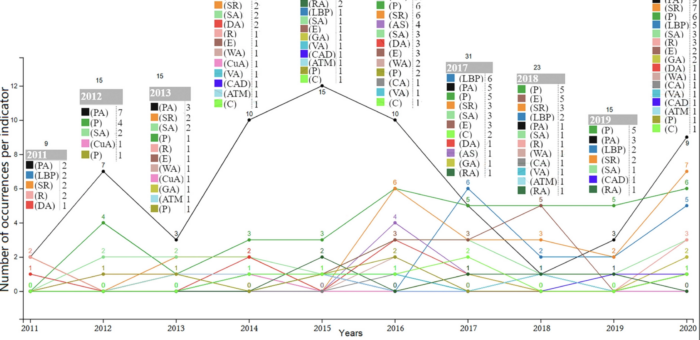
[caption id="attachment_4329" align="alignright" width="450"] Occurrences of the most commonly used learning analytic indicators over the past 10 years[/caption] Background: During the past decade, the increasingly heterogeneous field of learning analytics has been critiqued for an over-emphasis on data-driven approaches at the expense of paying attention to learning designs. Method and objective: In response to this critique, we investigated the role of learning design in learning analytics through a systematic literature review. 161 learning analytics (LA) articles were examined to identify indicators that were based on learning design events and their associated metrics. Through this research, we address two objectives. First, to achieve a better alignment between learning design and learning analytics by proposing a reference framework, where we present possible connections between learning analytics and learning design. Second, to present how…
Read More
Gender & STEM Conference 2022 – EduTec Member Dana Kube presented her Ph.D. work

Gender & STEM Conference 2022 – EduTec Member Dana Kube presented her Ph.D. work

Assessment, Conference, Conference, Digitalisation, Event, Higher Education, Journal, Learning Design, Publication, Workshop
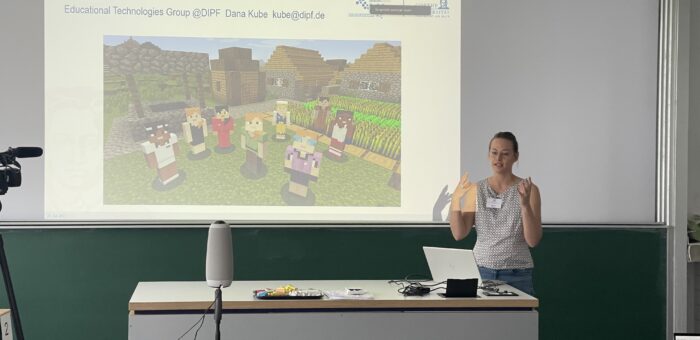
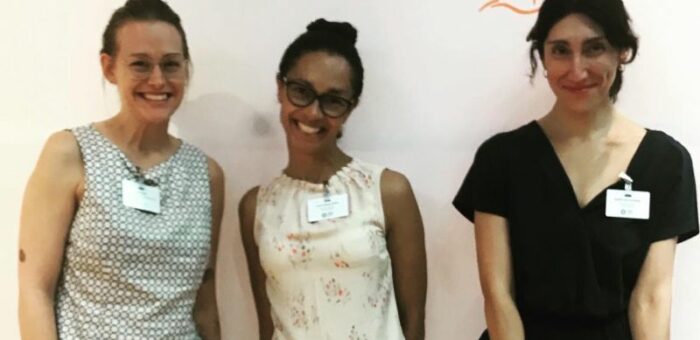
A few impressions: After a two-year break, scholars can finally meet again for a personal exchange at the "Gender & STEM Conference". I was able to meet so many exciting people and studies, and I think that we German universities have benefited especially from the intersectional and feminist perspectives from the USA, Canada and the Netherlands: How do transgender students experience support in Computer Science? What can universities do to keep students of colour and especially women* of colour longer in STEM programmes? Stop fixing Women* in STEM was the tenor, fix the System: I go back to Frankfurt with a lot of smart approaches on the institutional and pedagogical level and a lot of encouraging feedback on my PhD thesis on Gender in STEM/Technology. My personal highlight was meeting…
Read More
HIKOF-DL – 3rd Committee Meeting with Industry Members

HIKOF-DL – 3rd Committee Meeting with Industry Members

Artificial Intelligence, Assessment, Higher Education, Learning Analytics, Project, Transfer Activity
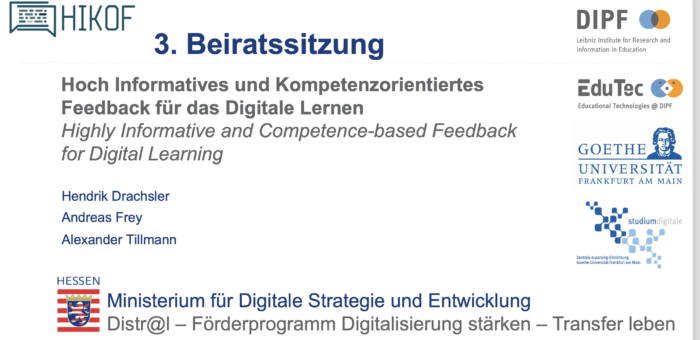
On 11.7.2022, team members of the HIKOF-DL project held its third meeting with the project committee members consisting of industry partners. The partner companies / institutions include Goethe Business School, Provadis, GIZ, Deutsche Bahn, Mercedes Benz, Academie für Bildungsforschung und Lehrerbildung. The three project leaders are Prof. Dr. Hendrik Drachsler, Prof. Dr. Andreas Frey (Goethe University Frankfurt) and Dr. David Weiss (studiumDigitale, Goethe University Frankfurt). In the meeting, Prof. Dr. Hendrik Drachsler and team members presented the ongoing research work namely the pilot study involving the course "Einführung in Unterricht sowie Diagnostik und Beratung" taught by Prof. Dr. Andreas Frey, with ca. 1000 students. One of the project aims is to make course assessment less time-consuming for the teaching staff, as this was a significant concern in such a course…
Read More