Kickoff Meeting of HICOF-DL – Highly Informative and Competence-based Feedback for Digital Learning

Kickoff Meeting of HICOF-DL – Highly Informative and Competence-based Feedback for Digital Learning

Computational Psychometrics, Higher Education, Learning Analytics, Project
Currently, almost all students learn only digitally at home, because in the wake of the COVID 19 pandemic, universities have largely converted their teaching to online courses. But the virtual lectures and seminars often still lack individual feedback for learners. A new project conducted by the DIPF | Leibniz Institute for Human Development and Educational Information and the Goethe University Frankfurt aims to change that. The researchers want to develop a software tool that uses modern, automated evaluation methods to help provide accurate feedback. Derzeit lernen fast alle Studierenden nur digital zu Hause, denn im Zuge der COVID-19-Pandemie haben die Hochschulen ihren Lehrbetrieb größtenteils auf Online-Veranstaltungen umgestellt. Doch den virtuellen Vorlesungen und Seminaren mangelt es häufig noch an individuellen Rückmeldungen für die Lernenden. Ein neues, vom DIPF | Leibniz-Institut für…
Read More
New Pub: Towards Automatic Collaboration Analytics for Group Speech Data Using Multimodal Learning Analytics

New Pub: Towards Automatic Collaboration Analytics for Group Speech Data Using Multimodal Learning Analytics

General education, Journal, Multimodal Learning Analytics, Open access, Publication
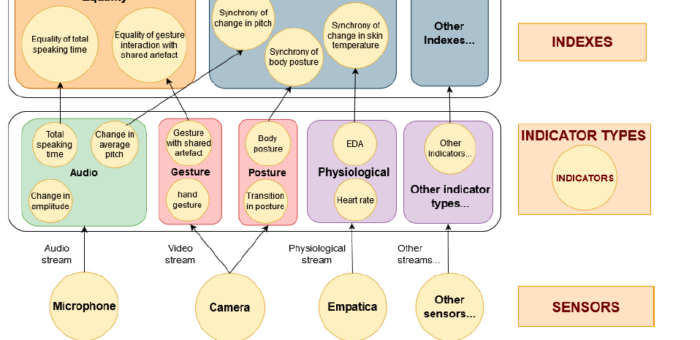
Collaboration is an important 21st Century skill. Co-located (or face-to-face) collaboration (CC) analytics gained momentum with the advent of sensor technology. Most of these works have used the audio modality to detect the quality of CC. The CC quality can be detected from simple indicators of collaboration such as total speaking time or complex indicators like synchrony in the rise and fall of the average pitch. Most studies in the past focused on “how group members talk” (i.e., spectral, temporal features of audio like pitch) and not “what they talk”. The “what” of the conversations is more overt contrary to the “how” of the conversations. Very few studies studied “what” group members talk about, and these studies were lab based showing a representative overview of specific words as topic clusters…
Read More
Best Paper award @LAK21 – Quantum of Choice

Best Paper award @LAK21 – Quantum of Choice

Award, Conference, Empirical Study, Higher Education, Learning Analytics, Open access, Publication
Learning analytics dashboards (LADs) are designed as feedback tools for learners, but until recently, learners rarely have had a say in how LADs are designed and what information they receive through LADs. To overcome this shortcoming, we have developed a customisable LAD for Coursera MOOCs on which learners can set goals and choose indicators to monitor. Following a mixed-methods approach, we analyse 401 learners’ indicator selection behaviour in order to understand the decisions they make on the LAD and whether learner goals and self-regulated learning skills influence these decisions. We found that learners overwhelmingly chose indicators about completed activities. Goals are not associated with indicator selection behaviour, while help-seeking skills predict learners’ choice of monitoring their engagement in discussions and time management skills predict learners’ interest in procrastination indicators. The…
Read More
Joshua Weidlich joins the team

Joshua Weidlich joins the team

Computational Psychometrics, Learning Design, Team
Starting April 2021, Joshua Weidlich joins the team as PostDoctoral researcher. He completed his PhD on social presence in online learning environments at the FernUniversität in Hagen in February 2021. He holds a Master's Degree in E-Learning and Media Education from Heidelberg University of Education as well as a Bachelor's Degree in Educational Science from Chemnitz University of Technology. See profile page for more information.
Read More
New E+ project RAPIDE – Relevant assessment and pedagogies for inclusive digital education

New E+ project RAPIDE – Relevant assessment and pedagogies for inclusive digital education

Higher Education, Learning Analytics, Press, Project
The European strategic project in higher education titled RAPIDE- Relevant assessment and pedagogies for inclusive digital education starts on Monday, March 1st 2021. The project, coordinated by the Faculty of Organization and Informatics (FOI) of the University of Zagreb, is the 24-month project funded under the Erasmus + program of the European Commission in the total amount of 219,085 euros. The goal of this  project is to co-create, implement and share innovative pedagogies and aligned assessment for relevant and inclusive digital education in order to deal with the COVID-19 induced and similar crises and to support meaningful digital transformation of higher education in (post)COVID era. The kick-off meeting of the project team including the coordinator and project partners - School of Medicine of the University of Zagreb, University of Rijeka,…
Read More
Kickoff Meeting: MILKY-PSY – Multimodal Immersive Learning with Artificial Intelligence for Psychomotor Skills

Kickoff Meeting: MILKY-PSY – Multimodal Immersive Learning with Artificial Intelligence for Psychomotor Skills

Digitalisation, Higher Education, Multimodal Learning Analytics, Project
Those who want to learn a sport train new psychomotor skills. Until now, this has required role models such as teachers on site who explain, demonstrate and assess certain processes. A consortium around the Cologne Game Lab of the TH Köln is developing a learning environment with artificial intelligence (AI) to support the training process as part of the joint research project MILKI-PSY.   Wer eine Sportart erlernen will, trainiert neue psychomotorische Fähigkeiten. Bislang werden dafür Vorbilder wie Lehrerinnen und Lehrer vor Ort benötigt, die bestimmte Abläufe erklären, zeigen und beurteilen. Ein Konsortium um das Cologne Game Lab der TH Köln entwickelt im Rahmen des Verbundforschungsprojekts MILKI-PSY eine Lernumgebung mit künstlicher Intelligenz (KI), die den Trainingsprozess unterstützen soll. Künstlerische, sportliche und handwerkliche Tätigkeiten erfordern psychomotorische Fähigkeiten, bei denen körperliche Bewegungen mit…
Read More
KI@Schule – Virtueller Expert*innen-Workshop

KI@Schule – Virtueller Expert*innen-Workshop

Artificial Intelligence, Learning Analytics, Project, School, Workshop
Prof. Dr. Hendrik Drachsler wurde von der Deutschen Telekom-Stiftung mit 15 weiteren Expert*innen zum virtuellen Workshop „KI@Schule – Zwischen Wunsch und Wahrscheinlichkeit“ am 25. Februar 2021 eingeladen, um die Befunde der Trend- und Zukunftsstudie „Künstliche Intelligenz in der schulischen Bildung“ zu diskutieren. Prof. Dr Hendrik Drachsler and 15 other experts were invited by the Deutsche Telekom Foundation to the virtual workshop "KI@Schule - Zwischen Wunsch und Wahrscheinlichkeit" on 25 February 2021 to discuss the findings of the trend and future study "Künstliche Intelligenz in der schulischen Bildung".
Read More
NEW Newsletter and Update on AR4STEAM

NEW Newsletter and Update on AR4STEAM

Augmented Reality, Digitalisation, Project, Publication, Report, School
AR4STE(A)M Newsletter 2 We have the pleasure to update you by this Newsletter with advance made in our project, which is designed to provide attractive means and ways  to improve current technological methods, encouraging STEAM education. Joining us, you will find in our publications a lot of useful information, tips and new opportunities for modern and effective teaching.
Read More
Nina Seidenberg joins the team

Nina Seidenberg joins the team

Learning Analytics, Team
Starting January 1st 2021 Nina Seidenberg joins the EduTech team. She has a part time position at the DIPF and is also working for studiumdigitale (Goethe University). She was one of the organizing chairs of the 10th international Learning Analytics and Knowledge Conference, one of the very first conferences that was moved to the virtual space in spring 2020.Her research focuses on the management and design of virtual conferences.
Read More
Onur Karademir joins the team

Onur Karademir joins the team

Learning Analytics, Team
Starting February 1st 2021 Onur Karademir joins the EduTec team as a PhD candidate. During his studies in M.Sc. Computer Science at the Goethe University Frankfurt he worked at the studential think thank #DigitalChangeMaker of Hochschulreform Digitalisierung. After graduating he founded in 2020 the StartUp StudyCore which delivers EdTech Tools for Universities and Schools. In his research Onur will be working on various Learning Analytics algorithms to distinguish successful learning strategies and extract the acquired skills in a learning environment. Furthermore he will be working on didactical feedback to support the individual learning process.     
Read More