New project ML2MT: Artificial Intelligence across disciplines

New project ML2MT: Artificial Intelligence across disciplines

Artificial Intelligence, Learning Analytics, Project, School
With almost 10 million euros in funding, the Volkswagen Foundation encourages research projects that explore how artificial intelligence will affect society. Goethe University Frankfurt (GU) was successful with an application that looks at developments in human-machine interaction in education. "From Machine Learning to Machine Teaching (ML2MT) - Making Machines AND Humans Smarter" - this is the title of the project that the economist Prof. Oliver Hinz applied for in an interdisciplinary project together with colleagues from various subjects. The success of learning machines, as in the prime example of the board game Go (in the computer version "AlphaGo Zero"), has inspired scientists. Their project aims at a better understanding of how humans and machines in collaborative human-AI systems can develop new knowledge in symbiotic interaction with each other. To this…
Read More
Two new research grants on AI in Higher Education

Two new research grants on AI in Higher Education

Artificial Intelligence, Higher Education, Learning Analytics, Project
The EduTec group contributed to two winning research grants on AI in Higher Education for the upcoming four years. The Federal Ministry of Education and Research (BMBF) is thus strengthening Frankfurt as an excellent centre for educational technologies, especially AI in Education (Learning Analytics). The federal-state initiative “Artificial Intelligence in Higher Education” supports two projects at the Goethe University Frankfurt. One of the projects is a cooperation project under the Goethe University Frankfurt direction, together with the University of Bremen, the FU Berlin, the HU Berlin, and the distance university in Hagen. The IMPACT project (IMPlementing AI-based feedbaCk and assessment with Trusted learning analytics in universities) is about the (partially) automated analysis of texts. Along the Student Life Cycle, prospective students, newcomers and students should receive text-based, highly informative and…
Read More
New Pub: Analysis of the “D’oh!” moments.

New Pub: Analysis of the “D’oh!” moments.

Artificial Intelligence, Conference, Conference, Further Education, Higher Education, Lifelong Learning, Multimodal Learning Analytics, Publication
“Soul and body, I suggest reacting sympathetically upon each other. A change in the state of the soul produces a change in the shape of the body and conversely, a change in the shape of the body produces a change in the state of the soul.” To test this hypothesis proposed by Aristotle, our bachelor student Tetiana Buraha investigated the physiology of students performing task-switching exercises. The physiological data were collected using an Empatica E4 band. The performances of the students were compared against the physiological data using descriptive statistics and machine learning techniques. The analysis of Tetiana enabled the identification of interesting correlations between galvanic skin response and performance, and models to predict performance based on the physiological data. Results of her excellent thesis were published and presented at…
Read More
New Pub: A short history, emerging challenges and co-operation structures for Artificial Intelligence in education

New Pub: A short history, emerging challenges and co-operation structures for Artificial Intelligence in education

Artificial Intelligence, Higher Education, Journal, Lifelong Learning, Publication, School
To accompany the special issue in Artificial Intelligence and Education, this article presents a short history of research in the field and summarises emerging challenges. We highlight key paradigm shifts that are becoming possible but also the need to pay attention to theory, implementation and pedagogy while adhering to ethical principles. We conclude by drawing attention to international co-operation structures in the field that can support the interdiscipniary perspectives and methods required to undertake research in the area. Reference: Mavrikis, M., Cukurova, M.,  Di Mitri, D., Schneider, J., & Drachsler, H. (2021). A short history, emerging challenges and co-operation structures for Artificial Intelligence in education. Bildung und Erziehung 2021 74:3, 249-263. https://doi.org/10.13109/buer.2021.74.3.249.
Read More

Ioana Jivet joins the team

Artificial Intelligence, Higher Education, Learning Analytics, Learning Design, Team
Ioana Jivet is Associate Researcher at EduTech group at DIPF Leibniz Institute for Research and Information in Education. Ioana obtained her Masters degree in Computer Science in 2016 from the TU Delft and then pursued a PhD at the Open University of the Netherlands which she obtained in March 2021 Cum Laude. Her research focused on designing learner-facing learning analytics dashboards that foster the development of self-regulated learning skills. Over the past years, she has contributed to Competen-SEA, a capacity building project in South-East Asia around MOOCs, and SHEILA, a research project that investigated the adoption of learning analytics in European higher education institutions and built a policy development framework for HEIs to facilitate adoption. At the moment, Ioana is serving on the Executive Committee of the Society of Learning…
Read More
New Pub: Are We There Yet? – A Systematic Literature Review on Chatbots in Education

New Pub: Are We There Yet? – A Systematic Literature Review on Chatbots in Education

Artificial Intelligence, General education, Journal, Learning Analytics, Literature review, Open access, Publication
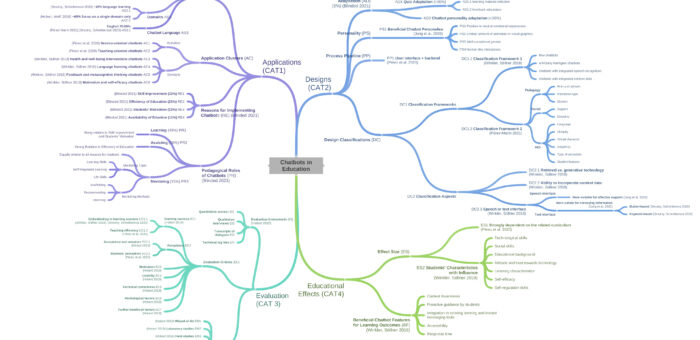
Are We There Yet? - A Systematic Literature Review on Chatbots in Education Chatbots are a promising technology with the potential to enhance workplaces and everyday life. In terms of scalability and accessibility, they also offer unique possibilities as communication and information tools for digital learning. In this work, we present a systematic literature review investigating the areas of education where chatbots have already been applied, explore the pedagogical roles of chatbots, the use of chatbots for mentoring purposes, and their potential to personalize education. We conducted a preliminary analysis of 2,678 publications to perform this literature review, which allowed us to identify 74 relevant publications for chatbots’ application in education. Through this, we address five research questions that, together, allow us to explore the current state-of-the-art of this educational…
Read More
SoLAR webinar on: Investigating persistent and new challenges of learning analytics

SoLAR webinar on: Investigating persistent and new challenges of learning analytics

Artificial Intelligence, Computational Psychometrics, Higher Education, Keynote, Learning Analytics, Learning Design, Multimodal Learning Analytics, School, Workshop
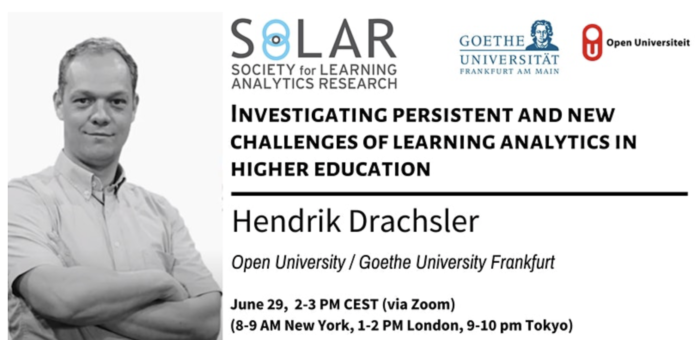
On 29 June 2021, Hendrik Drachsler gave an invited webinar for the SoLAR webinar channel where he reflected the process of applying learning analytics solutions within higher education settings and schools, its implications, and the critical lessons learned in the Trusted Learning Research Program. The talk focused on the experience of edutec.science research collective consisting of researchers from the Netherlands and Germany that contribute to the Trusted Learning Analytics (TLA) research program. The TLA program aims to provide actionable and supportive feedback to students and stands in the tradition of human-centred learning analytics concepts.  It, therefore, applies sensor technology to support psychomotor as well as web technology to support meta-cognitive and collaborative learning skills with high-informative feedback methods. Hendrik applies validated measurement instruments from the field of psychometric and investigates…
Read More
KI@Schule – Virtueller Expert*innen-Workshop

KI@Schule – Virtueller Expert*innen-Workshop

Artificial Intelligence, Learning Analytics, Project, School, Workshop
Prof. Dr. Hendrik Drachsler wurde von der Deutschen Telekom-Stiftung mit 15 weiteren Expert*innen zum virtuellen Workshop „KI@Schule – Zwischen Wunsch und Wahrscheinlichkeit“ am 25. Februar 2021 eingeladen, um die Befunde der Trend- und Zukunftsstudie „Künstliche Intelligenz in der schulischen Bildung“ zu diskutieren. Prof. Dr Hendrik Drachsler and 15 other experts were invited by the Deutsche Telekom Foundation to the virtual workshop "KI@Schule - Zwischen Wunsch und Wahrscheinlichkeit" on 25 February 2021 to discuss the findings of the trend and future study "Künstliche Intelligenz in der schulischen Bildung".
Read More
New Pub: Beitrag zu Buch: Digitale Bildung und Künstliche Intelligenz in Deutschland

New Pub: Beitrag zu Buch: Digitale Bildung und Künstliche Intelligenz in Deutschland

Artificial Intelligence, Multimodal Learning Analytics, Publication
Das Buch "Digitale Bildung und Künstliche Intelligenz in Deutschland" mit unserem Kapitel "Der multimodale Lern-Hub: Ein Werkzeug zur Sammlung individualisierbarer und sensorgestützter multimodaler Lernerfahrungen" wurde veröffentlicht. In diesem Kapitel wird ein Tool vorgestellt, mit dem Forscher anpassbare Prototypen erstellen können, um Lernaufgaben mithilfe multimodaler Daten zu untersuchen. References: Schneider, J., Di Mitri, D., Limbu, B., & Drachsler, H. (2020). Der multimodale Lern-Hub: Ein Werkzeug zur Erfassung individualisierbarer und sensorgestützter multimodaler Lernerfahrungen. In Digitale Bildung und Künstliche Intelligenz in Deutschland (pp. 537-557). Springer, Wiesbaden.
Read More