
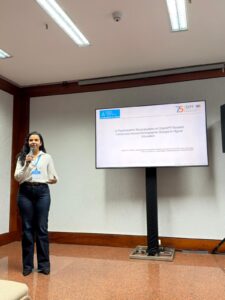
 At the 35th Brazilian Congress on Informatics in Education (CBIE 2026), Fabíola Gonçalves presented the paper “A Psychometric Re-evaluation of ChatGPT-Related Constructs Across Demographic Groups in Higher Education”.
The study aims to investigate ChatGPT adoption on Higher Education by empirically evaluating AI literacy constructors across demographic characteristic. We apply and psychometrically re-evaluate a validated AI Literacy Scale among 270 higher education students to measure students’ factual knowledge, Actual Use, Use Value, and Attitude toward generative AI. The findings support the use of the instrument in comparative AI literacy studies, provide evidence on demographic variability in students’ engagement with generative AI, and indicate that the instrument remais consistent with the original study, supporting its applicability across samples.
In addition, descriptive analysis suggests an increased perceived understanding of ChatGPT alongside a growing demand for information and training related to generative AI. Importantly, the higher mean average on the Actual Use scale corresponds to usage at least on a weekly basis, indicating that engagement with ChatGPT has become more regular and increasingly integrated into students’ academic routines. At the same time, while students’ self-assessed knowledge appears to have increased over time, the levels of factual knowledge remain remarkably similar across studies and show little variation by gender or age. This discrepancy between perceived and actual knowledge points to a critical challenge for higher education institutions: the need to design strategies that foster not only confidence in using generative AI, but also substantive, practical, and ethically grounded proficiency. Regarding demographic characteristics, gender analyses revealed a significant effect on factual knowledge: men showed marginally higher factual knowledge and more positive attitudes, whereas women reported higher Use Value. However, these differences were associated with small effect sizes.
The aforementioned findings also have implications for both research and educational practice. From a research perspective, the demonstrated stability of the AI Literacy Scale supports its use in comparative studies across different educational settings, contributing to the accumulation of evidence on students’ AI literacy as generative AI becomes more widespread and mature. From a practical perspective, the instrument has the potential to support higher education institutions in assessing AI literacy and identifying strengths and weaknesses across different dimensions of students’ knowledge, use, perceived value, and attitudes toward generative AI.
The paper is available via the following link: https://sol.sbc.org.br/index.php/sbie/article/view/45721