
New Pub: How Students Think About and Act Upon Personalized, Automated Feedback on Transactivity

New Pub: How Students Think About and Act Upon Personalized, Automated Feedback on Transactivity

Computer-supported collaborative learning, Conference, Feedback, Higher Education, Publication
A key factor for success in collaborative learning environments is transactivity. This process, whereby learners engage with and build upon the ideas of others, is crucial for learning outcomes. In today's digital learning environments, AI-powered speech and text analysis can be used to measure the extent to which learners interact with one another. In a recent randomized field study involving 252 student teachers, a research team examined how different forms of automated feedback influence the transactivity in online discussions. The study compared basic feedback (BAF), consisting of general information and a performance summary, with highly informative feedback (HIF), consisting of highly personalized, detailed feedback on various aspects of transavtivity. The results were surprising: Although the participants rated the personalized feedback significantly more positively, it did not lead to any measurable…
Read More
New Pub: Recommendations for Higher Education in the Age of Generative AI

New Pub: Recommendations for Higher Education in the Age of Generative AI

Artificial Intelligence, Higher Education, Publication, Report
Generative AI cannot be treated as just another digital tool that has come along. As it becomes more and more embedded in higher education, universities face the challenge of responsibly navigating the many challenges and opportunities that generative AI brings with it. One central guiding principal for institutions and stakeholders engaged with generative AI is intellectual sovereignty, which the German Science and Humanities Council (Wissenschaftsrat, WR) highlights in its newly published position paper, which was presented in a digital press release on 06.07.2026. Intellectual sovereignty refers to the ability to think independently, exercise critical judgment and maintain autonomy in the creation and evaluation of knowledge. Rather than relying uncritically on AI-generated outputs, this concept encourages students, educators and institutions to actively question, assess and contextualize information. By placing intellectual sovereignty…
Read More
Personalizing running training with immersive technologies using a multimodal framework

Personalizing running training with immersive technologies using a multimodal framework

Journal, New Pub
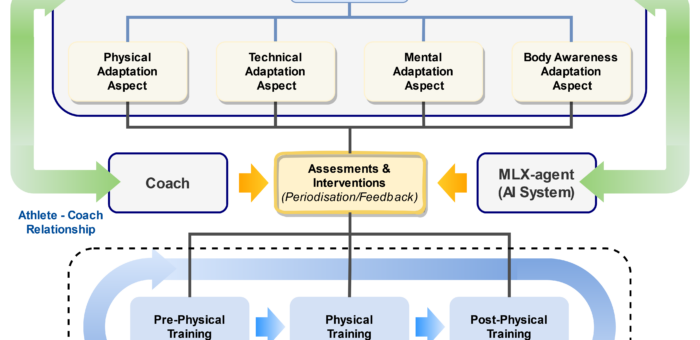
To improve performance and prevent injuries, running training needs proper personalized supervision and planning. This study examines the factors that influence running training programs, and the benefits and challenges of personalized plans. It also investigates how multimodal, immersive and artificial intelligence (AI) technologies can improve personalized training. We did an exploratory sequential mixed research with running coaches. We analyzed the data and found relevant factors of the training process. We recognized four key aspects for running training: physical, technical, mental and body awareness. We used these aspects to create a framework that proposes multimodal, immersive and AI technologies to help personalized running training. It also lets coaches guide their athletes on each aspect personally. The framework aims to personalize the training by showing how coaches and multimodal learning experience agents…
Read More