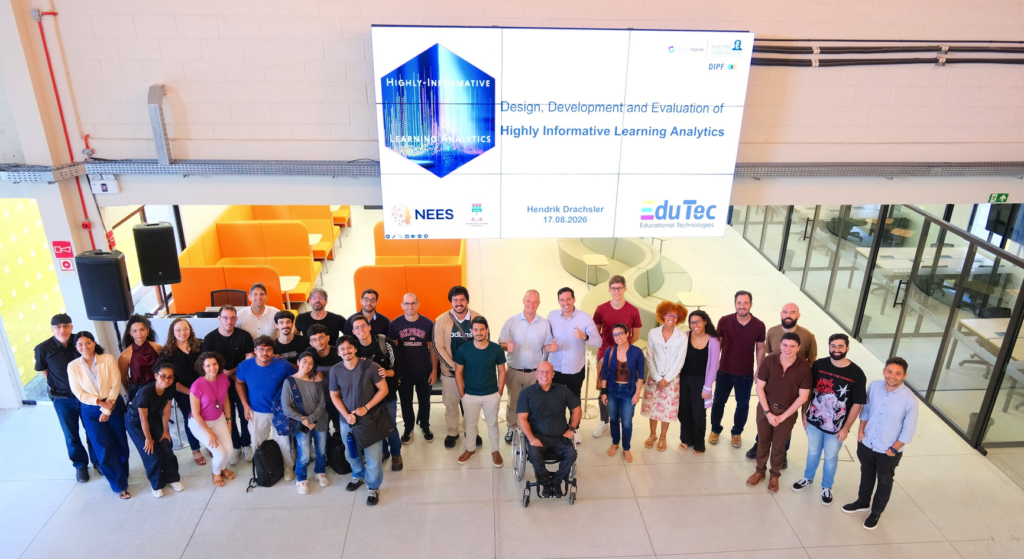
 In August, Hendrik Drachsler was invited to give a talk at the NEES research centre of the Federal University of Alagoas (UFAL) in Maceió, hosted by Prof. Dr Diego Dermeval. The lecture, “Design, Development and Evaluation of Highly Informative Learning Analytics”, was organised together with the PPGI graduate programme and drew a full house of 80 participants.
Hendrik’s argument was straightforward. Most learning analytics is not wrong; it is just not informative enough. Counting clicks and minutes tells a teacher that something happened, not what to do about it. Moving from descriptive to truly informative analytics takes three things: indicators grounded in learning theory, a design process that includes the educators who will use the results, and a governance framework that makes the whole thing defensible. He presented the tools developed for this at DIPF and in the EduTec group in Frankfurt: OpenLAIR, an open repository of validated indicators, the FoLA2 learning design method, and the DELICATE framework for trustworthy learning analytics.
The discussion afterwards was a highlight of the visit. The questions from the NEES doctoral researchers were sharper than what Hendrik usually encounters in Europe, for a clear reason: they cannot assume the infrastructure. A system that needs a stable connection and a recent laptop solves nothing in most of the contexts they work in. That constraint produces better engineering, and it is exactly why this collaboration is worth building.
Thanks go to Diego Dermeval and the NEES team for the invitation and for an excellent exchange.