Dissemination event for the AFELK project

Dissemination event for the AFELK project

Event, Feedback, Project, Project meeting, Research topic, School, Target group
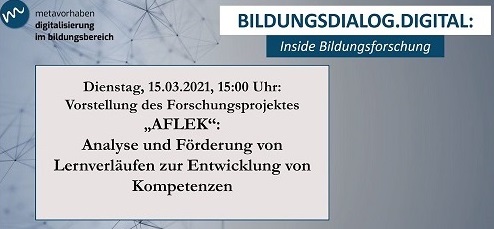
Digital lessons can help track individual student learning progression, analyze the extent to which they are productive and report this information back to teachers. But how can this individual learning progression and the learning difficulties that arise in the process be depicted? The research project AFLEK "Analyse und Förderung von Lernverläufen zur Entwicklung von Kompetenzen" (Analysis and Support of Learning Trajectories for the Development of Competencies) is currently looking for answers to this issue. The interdisciplinary project team uses so-called teacher dashboards to provide physics teachers with almost real-time feedback on the learning progress of their students. The information from digital teaching units helps identify productive and unproductive learning progression; this information can then help to automatically recolonize learning difficulties und derive feedback for the teachers to support more productive…

Read More
Podcast “FutureSchool”: Child reporter talks with Scientist about Educational Technologies

Podcast “FutureSchool”: Child reporter talks with Scientist about Educational Technologies

Artificial Intelligence, Augmented Reality, Competence development, Computer-supported collaborative learning, Digitalisation, Event, Feedback, Invited talk, Promotion activity, Robots in Education, School, Transfer Activity
The German podcast "FutureSchool" looks at the classroom of the future and which technical aids for learning could be conceivable, but are also already being developed. Luis and DIPF education expert and our colleague Dana Kube consider together where technology is superior to teachers and when, in turn, teachers are unbeatable as real people with real experiences: https://blog.bildungsserver.de/klassenzimmer-der-zukunft/ The three-part podcast "FutureSchool" was created as part of the BMBF project "enorM - Lernen von (ÜBER)MORGEN". In the project, which is part of the "Science Year 2022 - Inquired about!", pupils and researchers have exchanged ideas in numerous formats, for example about new subjects and digital learning support.
Read More
BR Radio: Roboter statt Lehrerinnen und Lehrer? Wie sollte die Schule der Zukunft aussehen?

BR Radio: Roboter statt Lehrerinnen und Lehrer? Wie sollte die Schule der Zukunft aussehen?

Artificial Intelligence, Invited talk, Learning Analytics, Learning Design, Robots in Education, School
Ist es denkbar, dass wir irgendwann keine echten Lehrer*innen mehr haben? Stattdessen fahren Roboter durch das Klassenzimmer und erklären alles? Wäre das überhaupt gut – wenn ja wie? Lasst uns gemeinsam darüber reden. Diese Sendung funktioniert in zwei Richtungen – ihr könnt natürlich alle Fragen stellen über Roboter in der Schule. UND: Ihr könnt einem Forscher sagen, bei was ihr wirklich gerne einen Roboter hättet. Denn das ist der Beruf von unserem Gast Onur Karademir – er promoviert im Bereich der Educational Technologies und findet raus, wann Lerntechnologien helfen und wann nicht. Die Sendung "RadioMikro" hier anhören
Read More
New Pub: Superpowers in the Classroom: Hyperchalk is an Online Whiteboard for Learning Analytics Data Collection

New Pub: Superpowers in the Classroom: Hyperchalk is an Online Whiteboard for Learning Analytics Data Collection

Computer-supported collaborative learning, Conference, Conference, Event, Further Education, General education, Higher Education, Learning Analytics, Lifelong Learning, Publication, School, Technical paper
A new system demonstration paper authored by Lukas Menzel, Sebastian Gombert, Daniele Di Mitri and Henrik Drachsler has been released as part of the ECTEL 2022 proceedings. In this paper, we present Hyperchalk, a self-hosted collaborative online whiteboard software. Similar to commercial solutions like Miro or Flinga, this software provides users with collaborative boards which they can use to draw, write or sketch together. However, unlike commercial solutions, Hyperchalk allows for collecting rich log data, which can be used to study the behaviour of its users and to allow Learning Analytics and studies on computer-supported collaborative learning. Moreover, Hyperchalk comes with a built-in replay mode which allows watching how users behave in its spaces. It supports the LTI1.3 standard, which enables seamless integration with learning management systems such as Moodle,…
Read More
New Pub: FoLA2 — A Method for Co-creating Learning Analytics–Supported Learning Design

New Pub: FoLA2 — A Method for Co-creating Learning Analytics–Supported Learning Design

Further Education, General education, Higher Education, Journal, Learning Analytics, Learning Design, Open access, Publication, School
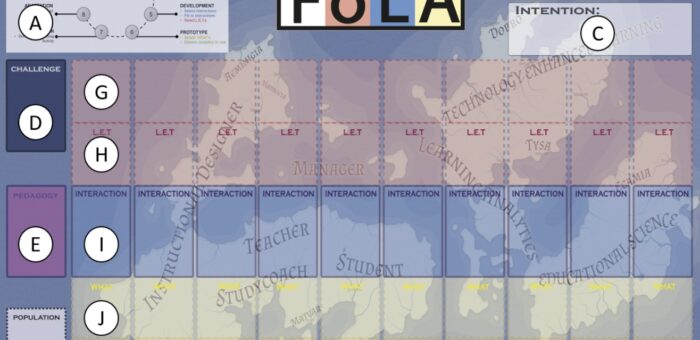
Finally, we have published an article about the FOLA2 method that we have used for over two years frequently to design Learning Analytics supported Learning Designs with teachers of various backgrounds. Learning activities are at the core of every educational design effort. Designing learning activities is a process that benefits from reflecting on previous runs of those activities. One way to measure the behaviour and effects of design choices is to use learning analytics (LA). The challenge, however, lies in the unavailability of an easy-to-use, LA-supported learning design (LD) method. We established a method—the Fellowship of Learning Activities and Analytics (FoLA2)—reinforced by a gameboard and cards to provide structure and inspiration. The method enables several participants with different roles to interact with a set of card decks to create an…
Read More
New Pub: Toward learning progression analytics — Developing learning environments for the automated analysis of learning using evidence-centred design

New Pub: Toward learning progression analytics — Developing learning environments for the automated analysis of learning using evidence-centred design

Computational Psychometrics, Journal, Learning Analytics, Learning Design, Open access, Project, Publication, School
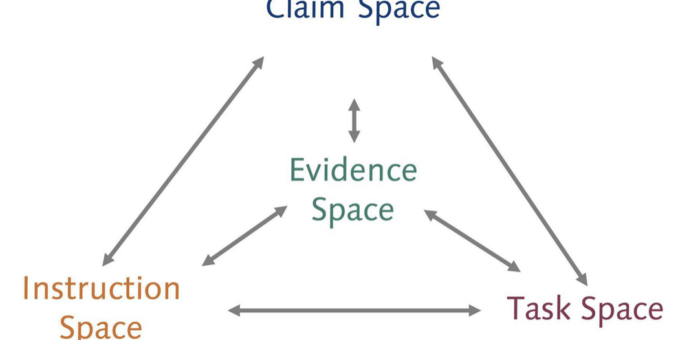
[caption id="attachment_4319" align="alignright" width="450"] A procedure for developing digital learning environments that allow for the automated assessment of learning.[/caption] National educational standards stress the importance of science and mathematics learning for today’s students. However, across disciplines, students frequently struggle to meet learning goals about core concepts like energy. Digital learning environments enhanced with artificial intelligence hold the promise to address this issue by providing individualized instruction and support for students at scale. Scaffolding and feedback, for example, are both most effective when tailored to students’ needs. Providing individualized instruction requires continuous assessment of students’ individual knowledge, abilities, and skills in a way that is meaningful for providing tailored support and planning further instruction. While continuously assessing individual students’ science and mathematics learning is challenging, intelligent tutoring systems show that it…
Read More
Transfer Workshop @ Digitaltag 2022 on highly informative and data-driven feedback with AI in higher education

Transfer Workshop @ Digitaltag 2022 on highly informative and data-driven feedback with AI in higher education

Artificial Intelligence, Conference, Event, Higher Education, Learning Analytics, Open access, School, Transfer Activity, Webinar, Workshop
The third Digitaltag will take place on June 24, 2022. The initiative "Digital for All" is behind the Digitaltag. The alliance of more than 25 organizations from the fields of civil society, culture, science, business, welfare and the public sector unites a common goal: to promote digital participation in Germany. Prof. Dr. Hendrik Drachsler contributes a talk on highly informative and data-driven feedback with AI in higher education. Feedback is a powerful element of all learning processes. However, it is difficult to offer highly informative feedback to large groups of learners. The Educational Technology Collective at Goethe University and the DIPF Leibniz Institute Frankfurt am Main are conducting research on this challenge in a variety of projects. In this talk, Professor Dr. Drachsler will present on designing highly informative feedback…
Read More
Keynote at LERN Jahrestagung 2022

Keynote at LERN Jahrestagung 2022

Computational Psychometrics, Higher Education, Invited talk, Keynote, Learning Analytics, Learning Design, School
On 30 March 2022, Hendrik Drachsler gave an invited keynote at the LERN conference 2022 where he reported on the latest research on data-driven high informative feedback in higher education and schools. The talk focused on the experience of edutec.science research collective that has been gained in the projects DIFA, HIKOF-DL, AFLEK and ALICE. The presentation provided an overview of actionable and supportive feedback to learners as well as the various technical products that the EduTec group has developed. It, therefore, applies web technology to support meta-cognitive and collaborative learning skills with high-informative feedback methods. Hendrik applies validated measurement instruments from the field of psychometrics and investigates to what extent Learning Analytics interventions can reproduce the findings of these instruments. He discussed the lessons learned from implementing TLA systems. He…
Read More
AR4STEAM Meeting in Brussels: Successfull Ending of our Erasmus Plus Cooperation with Schools

AR4STEAM Meeting in Brussels: Successfull Ending of our Erasmus Plus Cooperation with Schools

Augmented Reality, Conference, Digitalisation, Event, Learning Analytics, Project, School
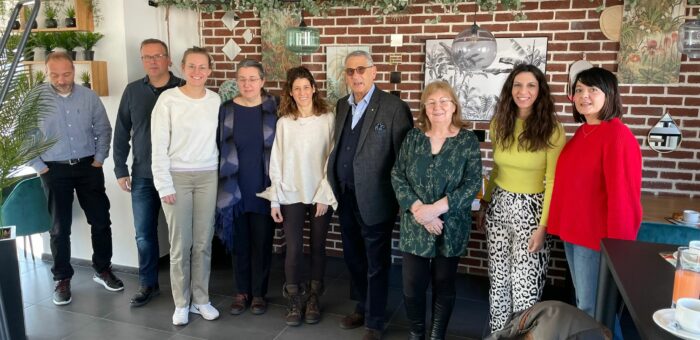
Today we gather in Brussels to celebrate the successful end of our 2,5 year collaboration on promoting Augmented Reality in STEM classes all over Europe. It has been our great pleasure to work on this EU project and to share a vision even in difficult times. #Schools #Science #STEM #Arts #Friendship #Europa #Europe #ErasmusPlus #Schools #AugmentedReality #Peace 
Read More
Interview with Bildung.Table

Interview with Bildung.Table

Artificial Intelligence, Higher Education, Learning Analytics, Press, Project, School
On 23.02.2022 Hendrik Drachsler was interviewed by Niklas Prenzel from Table.Media about Artificial Intelligence in university teaching and the joint project IMPACT. In the interview, he outlines how AI can support teaching and help reduce the burden on lecturers as well as giving answers to the concerns from other disciplines.   The interview "KI darf nur unterstützen, niemals entscheiden" is available in German in the Bildung.Table issue #46 from the 23rd of February can be read here.
Read More