Ioana Jivet joins the team

Ioana Jivet joins the team

Artificial Intelligence, Higher Education, Learning Analytics, Learning Design, Team
Ioana Jivet is Associate Researcher at EduTech group at DIPF Leibniz Institute for Research and Information in Education. Ioana obtained her Masters degree in Computer Science in 2016 from the TU Delft and then pursued a PhD at the Open University of the Netherlands which she obtained in March 2021 Cum Laude. Her research focused on designing learner-facing learning analytics dashboards that foster the development of self-regulated learning skills. Over the past years, she has contributed to Competen-SEA, a capacity building project in South-East Asia around MOOCs, and SHEILA, a research project that investigated the adoption of learning analytics in European higher education institutions and built a policy development framework for HEIs to facilitate adoption. At the moment, Ioana is serving on the Executive Committee of the Society of Learning…
Read More
QE Webinar series moderated by DIPF

QE Webinar series moderated by DIPF

Further Education, General education, Higher Education, Lifelong Learning, School, Webinar
The monthly QE Webinar Series showcases emerging research and exciting new developments in Quantitative Ethnography. These one-hour events begin with a 30-minute presentation by scholars from the QE community, followed by 30 minutes of moderated discussion. Attendance is free and open to anyone who is interested! The DIPF is currently moderating a series of webinars of the Quantified Ethnography (QE) community as pre-events to the QE conference taking place in October. So far we have been discussing the following topics and the recording can be watched back: Putting the E in QE: How Quantitative Ethnography can Enrich Qualitative Analyses Yotam Hod University of Haifa QE Data ChallengeField Report: Reflecting on the benefits of multidisciplinary research teams Daniel Spikol University of Copenhagen, DK Barbara Wasson University of Bergen, Norway Stefano Schiavetto…
Read More
Gianluca Romano joins the team

Gianluca Romano joins the team

Higher Education, Multimodal Learning Analytics, Team
Starting July 2021, Gianluca Romano joins the team as a doctoral researcher. He holds a Master's as well as a Bachelor's degree in Computer Science from the Goethe University Frankfurt. He finished his study with a thesis on an Intelligent Tutoring System for dancing which was also published in an online journal. Further, he has experience as an AI Engineer and currently is also employed as a Machine Learning Engineer.
Read More
SoLAR webinar on: Investigating persistent and new challenges of learning analytics

SoLAR webinar on: Investigating persistent and new challenges of learning analytics

Artificial Intelligence, Computational Psychometrics, Higher Education, Keynote, Learning Analytics, Learning Design, Multimodal Learning Analytics, School, Workshop
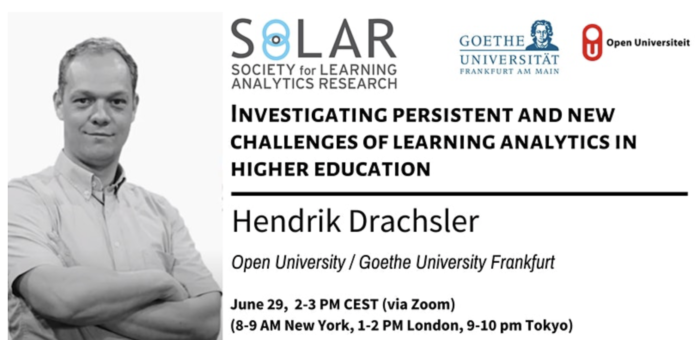
On 29 June 2021, Hendrik Drachsler gave an invited webinar for the SoLAR webinar channel where he reflected the process of applying learning analytics solutions within higher education settings and schools, its implications, and the critical lessons learned in the Trusted Learning Research Program. The talk focused on the experience of edutec.science research collective consisting of researchers from the Netherlands and Germany that contribute to the Trusted Learning Analytics (TLA) research program. The TLA program aims to provide actionable and supportive feedback to students and stands in the tradition of human-centred learning analytics concepts.  It, therefore, applies sensor technology to support psychomotor as well as web technology to support meta-cognitive and collaborative learning skills with high-informative feedback methods. Hendrik applies validated measurement instruments from the field of psychometric and investigates…
Read More
New Pub: An exploratory latent class analysis of student expectations towards learning analytics services

New Pub: An exploratory latent class analysis of student expectations towards learning analytics services

Empirical Study, Higher Education, Open access, Publication
For service implementations to be widely adopted, it is necessary for the expectations of the key stakeholders to be considered. Failure to do so may lead to services reflecting ideological gaps, which will inadvertently create dissatisfaction among its users. Learning analytics research has begun to recognise the importance of understanding the student perspective towards the services that could be potentially offered; however, student engagement remains low. Furthermore, there has been no attempt to explore whether students can be segmented into different groups based on their expectations towards learning analytics services. In doing so, it allows for a greater understanding of what is and is not expected from learning analytics services within a sample of students. The current exploratory work addresses this limitation by using the three-step approach to latent class…
Read More
Kickoff Meeting of HICOF-DL – Highly Informative and Competence-based Feedback for Digital Learning

Kickoff Meeting of HICOF-DL – Highly Informative and Competence-based Feedback for Digital Learning

Computational Psychometrics, Higher Education, Learning Analytics, Project
Currently, almost all students learn only digitally at home, because in the wake of the COVID 19 pandemic, universities have largely converted their teaching to online courses. But the virtual lectures and seminars often still lack individual feedback for learners. A new project conducted by the DIPF | Leibniz Institute for Human Development and Educational Information and the Goethe University Frankfurt aims to change that. The researchers want to develop a software tool that uses modern, automated evaluation methods to help provide accurate feedback. Derzeit lernen fast alle Studierenden nur digital zu Hause, denn im Zuge der COVID-19-Pandemie haben die Hochschulen ihren Lehrbetrieb größtenteils auf Online-Veranstaltungen umgestellt. Doch den virtuellen Vorlesungen und Seminaren mangelt es häufig noch an individuellen Rückmeldungen für die Lernenden. Ein neues, vom DIPF | Leibniz-Institut für…
Read More
Meine KI-Forschung hilft dabei, produktive Lernverläufe zu identifizieren und Kompetenzen zu verbessern

Meine KI-Forschung hilft dabei, produktive Lernverläufe zu identifizieren und Kompetenzen zu verbessern

Artificial Intelligence, Higher Education, Multimodal Learning Analytics, Press
[This article appeared on bildungsserver.de and it was written by Christine Schumann for Deutscher Bildungsserver] Wie bei digitalen Lerneinheiten entstehende Daten für personalisiertes Feedback genutzt werden können. FRAGEN AN Daniele Di Mitri, der im April 2021 in der Kategorie Geistes- und Sozialwissenschaften zum AI-Newcomer des Jahres gewählt wurde. Am DIPF | Leibniz-Institut baut er gerade eine Forschungsgruppe zum Thema Künstliche Intelligenz auf, um verantwortungsvolle KI-Systeme für die Bildung zu entwickeln. Zurzeit konzentrieren sich seine Arbeiten auf praktische Lernaufgaben – und nicht auf allgemeine Lernsituationen im Klassenzimmer. Herr Di Mitri, sind Sie stolz auf Ihre Auszeichnung als „AI Newcomer“ des Jahres 2021? Ja, ich bin begeistert, dass ich im Rahmen des KI-Camps zum „AI Newcomer of 2021“ gewählt wurde. Das KI-Camp ist das nationale Event in Deutschland zur Künstlichen Intelligenz, das das Bundesministerium für…
Read More
Interview for Hessischer Rundfunk

Interview for Hessischer Rundfunk

Artificial Intelligence, Higher Education, Multimodal Learning Analytics, Press
Dr. Draniele Di Mitri was interviewed (in German) by Hessischer Rundfunk by Alexander Schmitt. The theme of the episode was: Artificial intelligence is penetrating deeper and deeper into our lives: we talk to computers, rely on their search results and will soon be driven by robot cars. The revolution is just beginning. What are young research talents in Hesse working on? [audio mp3="https://edutec.science/wp-content/uploads/2021/05/hr-info_wirtschaft_20210512_87919984-AudioTrimmer.com_.mp3"][/audio] Listen to the entire episode  Below the answer to the questions translated into English: *** You are interested in education and in technology - is it related to your parents? Yes, I believe I inherited my two main passions from my parents. My father was a first-generation software engineer and my mother was a teacher. In my teenage years, my father showed me how to create a…
Read More
Workshop on Multimodal Artificial Intelligence in Education (MAIEd’21) 

Workshop on Multimodal Artificial Intelligence in Education (MAIEd’21) 

Artificial Intelligence, Higher Education, Multimodal Learning Analytics, Workshop
1st International Workshop on Multimodal Artificial Intelligence in Education (MAIEd'21)  @ the 22nd International Conference on Artificial Intelligence in Education (AIED’2021) https://aied2021.science.uu.nl/ 14th June 2021, 9 am to 4 pm CET online workshop Website: https://maied.edutec.science/ - Proceedings to be published by CEUR (more…)
Read More
Best Paper award @LAK21 – Quantum of Choice

Best Paper award @LAK21 – Quantum of Choice

Award, Conference, Empirical Study, Higher Education, Learning Analytics, Open access, Publication
Learning analytics dashboards (LADs) are designed as feedback tools for learners, but until recently, learners rarely have had a say in how LADs are designed and what information they receive through LADs. To overcome this shortcoming, we have developed a customisable LAD for Coursera MOOCs on which learners can set goals and choose indicators to monitor. Following a mixed-methods approach, we analyse 401 learners’ indicator selection behaviour in order to understand the decisions they make on the LAD and whether learner goals and self-regulated learning skills influence these decisions. We found that learners overwhelmingly chose indicators about completed activities. Goals are not associated with indicator selection behaviour, while help-seeking skills predict learners’ choice of monitoring their engagement in discussions and time management skills predict learners’ interest in procrastination indicators. The…
Read More