EduTec@ AI Camp 2021 In dialogue. With algorithms. For society.

EduTec@ AI Camp 2021 In dialogue. With algorithms. For society.

Conference, Digitalisation, Workshop
https://kicamp.orgOn April 27, 2021, the German Federal Ministry of Education and Research (BMBF) and the German Informatics Society (GI) will bring together selected AI talents up to the age of 35 with renowned AI experts from all over the world at the AI Camp 2021 in Berlin. Whether universities, startups or think tanks: young AI researchers from alldisciplines and backgrounds will meet in interactive fishbowl discussions, lecture sessions or hands-on workshops and address transdisciplinary future issues from the fields of society, sustainability, production, science, health, mobility, art and media. Starting as early as January, the hybrid on- and offline event will offer participants the opportunity to actively participate in the program design and to network on a topic-by-topic basis in virtual workshop and discussion formats. Artificial intelligence is not only…
Read More
New Pub: A four-country cross-case analysis of academic staff expectations about learning analytics in higher education

New Pub: A four-country cross-case analysis of academic staff expectations about learning analytics in higher education

Higher Education, Journal, Learning Analytics, Open access, Publication
The purpose of this paper is to explore the expectations of academic staff to learning analytics services from an ideal as well as a realistic perspective. This mixed-method study focused on a cross-case analysis of staff from Higher Education Institutions from four European universities (Spain, Estonia, Netherlands, UK). While there are some differences between the countries as well as between ideal and predicted expectations, the overarching results indicate that academic staff sees learning analytics as a tool to understand the learning activities and possibility to provide feedback for the students and adapt the curriculum to meet learners' needs. However, one of the findings from the study across cases is the generally consistently low expectation and desire for academic staff to be obligated to act based on data that shows students…
Read More
New Pub: Understanding Graph Problem solving with the use of Eye-tracking and Epistemic Network Analysis

New Pub: Understanding Graph Problem solving with the use of Eye-tracking and Epistemic Network Analysis

Journal, Multimodal Learning Analytics, Open access, Publication, School
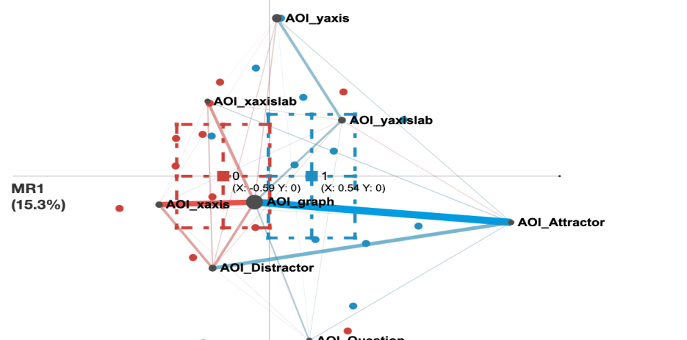
Epistemic Network Analyses of Economics Students’ Graph Understanding: An Eye-Tracking Study Learning to solve graph tasks is one of the key prerequisites of acquiring domain-specific knowledge in most study domains. Analyses of graph understanding often use eye-tracking and focus on analyzing how much time students spend gazing at particular areas of a graph—Areas of Interest (AOIs). To gain a deeper insight into students’ task-solving process, we argue that the gaze shifts between students’ fixations on different AOIs (so-termed transitions) also need to be included in holistic analyses of graph understanding that consider the importance of transitions for the task-solving process. Thus, we introduced Epistemic Network Analysis (ENA) as a novel approach to analyze eye-tracking data of 23 university students who solved eight multiple-choice graph tasks in physics and economics. ENA…
Read More
New Pub: Beitrag zu Buch: Digitale Bildung und Künstliche Intelligenz in Deutschland

New Pub: Beitrag zu Buch: Digitale Bildung und Künstliche Intelligenz in Deutschland

Artificial Intelligence, Multimodal Learning Analytics, Publication
Das Buch "Digitale Bildung und Künstliche Intelligenz in Deutschland" mit unserem Kapitel "Der multimodale Lern-Hub: Ein Werkzeug zur Sammlung individualisierbarer und sensorgestützter multimodaler Lernerfahrungen" wurde veröffentlicht. In diesem Kapitel wird ein Tool vorgestellt, mit dem Forscher anpassbare Prototypen erstellen können, um Lernaufgaben mithilfe multimodaler Daten zu untersuchen. References: Schneider, J., Di Mitri, D., Limbu, B., & Drachsler, H. (2020). Der multimodale Lern-Hub: Ein Werkzeug zur Erfassung individualisierbarer und sensorgestützter multimodaler Lernerfahrungen. In Digitale Bildung und Künstliche Intelligenz in Deutschland (pp. 537-557). Springer, Wiesbaden.
Read More
11th Brazilian – German Frontiers of Science and Technology Symposium

11th Brazilian – German Frontiers of Science and Technology Symposium

Conference, Digitalisation
Prof. Drachsler was invited to the 11th Brazilian – German Frontiers of Science and Technology Symposium. The focus of the event was on challenging times and progress of science & engineering with the current circumstances imposed by the COVID-19 pandemic. These times require creative approaches and stimulating individuals working on new solutions for the challenges of our time, realizing new solutions. In this view the BRAGFOST symposium aims to bring together young but experienced scientists and create the environment fostering a vibrant exchange with interesting colleagues from their own field and furthermore transdisciplinary exchange. The generalizable basis of complexity in our world already transcendent from science and natural systems more and more into our every days life – social systems, finances, economy up to education. Finding new solutions currently involves…
Read More
Learning Analytics Workshop at DELFI 2020

Learning Analytics Workshop at DELFI 2020

Conference, Workshop
On behalf of the Arbeitskreis Learning Analytics (Learning Analytics Working Group of the German Informatics Society) the digLL innovation-forum Trusted Learning Analytics organised and lead the workshop Learning Analytics on 14th September 2020 as part of the pre-conference workshops of the biggest German eLearning conference DELFI. Due to corona the workshop was fully online. This year, the workshop was focused on „Trusted Learning Analytics“ lead by Oliver Herrmann of the Goethe University Frankfurt am Main and „Data Literacy“ with Sven Judel of the RWTH Aachen.
Read More
TLA presented at Learning Analytics Learning Network (LALN)

TLA presented at Learning Analytics Learning Network (LALN)

Conference, Workshop
On 4th September 2020 Oliver Herrmann presented the current state of Trusted Learning Analytics (TLA) at a Learning Analytics Learning Network (LALN) workshop. LALN is a worldwide network of LA researchers. The workshop was held as a video conference as part of DELFI, Germany’s leading eLearning research conference. After the presentation, the meaning of “trusted” have been discussed in an international context, that brought new perspectives to be included in further research on TLA.  
Read More
New Pub: Learning Analytics Cookbook – How to Support Learning Processes Through Data Analytics and Visualization

New Pub: Learning Analytics Cookbook – How to Support Learning Processes Through Data Analytics and Visualization

General education, Learning Analytics, Publication
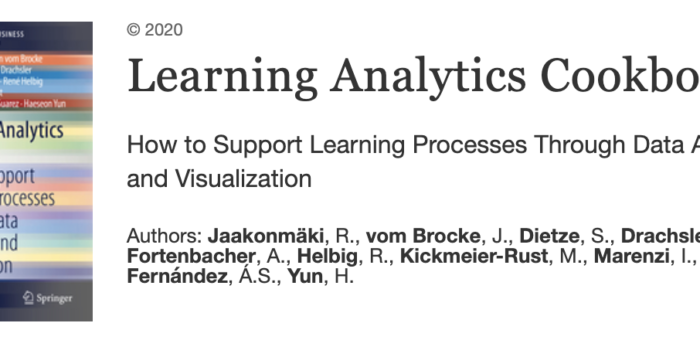
This book offers an introduction and hands-on examples that demonstrate how Learning Analytics (LA) can be used to enhance digital learning, teaching and training at various levels. While the majority of existing literature on the subject focuses on its application at large corporations, this book develops and showcases approaches that bring LA closer to smaller organizations, and to educational institutions that lack sufficient resources to implement a full-fledged LA infrastructure. In closing, the book introduces a set of software tools for data analytics and visualization, and explains how they can be employed in several LA scenarios. Reference: Jaakonmäki, R., vom Brocke, J., Dietze, S., Drachsler, H., Fortenbacher, A., Helbig, R., Kickmeier-Rust, M., Marenzi, I., Fernández, Á.S., Yun, H. (2020). Learning Analytics Cookbook - How to Support Learning Processes Through Data Analytics and Visualization. SpringerBriefs in Business Process Management, XI, 93, DOI: 10.1007/978-3-030-43377-2,…
Read More
Publication of the Compendium of Gamification Strategies: AR in STEM classes in the EU

Publication of the Compendium of Gamification Strategies: AR in STEM classes in the EU

Project, Publication
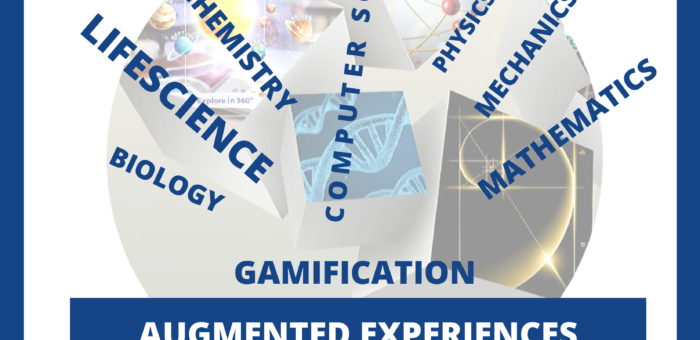
The only limit is our imagination: Augmented Reality Technology enters STEM classes in EU As a powerful storytelling tool, immersive media fundamentally change the way we interact with our environment. The EU-funded AR4STEAM project wants to use this potential for new ways of learning in school lessons in natural sciences and arts. With Augmented Reality (AR) we can merge digital dimension with the physical world and create completely new experiences. Reality becomes a creative canvas on which we can provide information in a completely new and exciting way. Artists and scientists have long recognized that immersive technologies appeal to recipients emotionally on a whole new level and create lasting impressions. AR makes the previously impossible a new reality. The only limit? Our imagination! Studies have shown that the use of…
Read More
From students with love: An empirical study on learner goals, self-regulated learning and sense-making of learning analytics in higher education

From students with love: An empirical study on learner goals, self-regulated learning and sense-making of learning analytics in higher education

Empirical Study, Open access, Publication
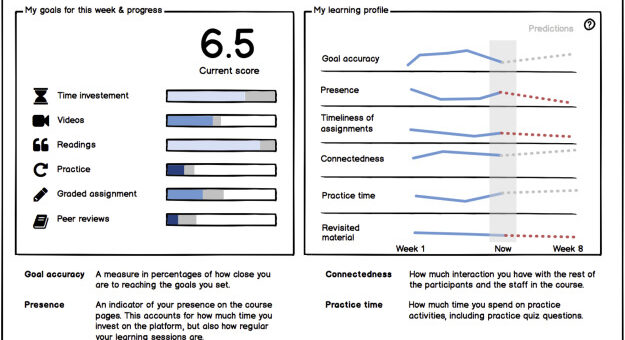
Unequal stakeholder engagement is a common pitfall of adoption approaches of learning analytics in higher education leading to lower buy-in and flawed tools that fail to meet the needs of their target groups. With each design decision, we make assumptions on how learners will make sense of the visualisations, but we know very little about how students make sense of dashboard and which aspects influence their sense-making. We investigated how learner goals and self-regulated learning (SRL) skills influence dashboard sense-making following a mixed-methods research methodology: a qualitative pre-study followed-up with an extensive quantitative study with 247 university students. We uncovered three latent variables for sense-making: transparency of design, reference frames and support for action. SRL skills are predictors for how relevant students find these constructs. Learner goals have a significant…
Read More