New Pub: Towards Automatic Collaboration Analytics for Group Speech Data Using Multimodal Learning Analytics

New Pub: Towards Automatic Collaboration Analytics for Group Speech Data Using Multimodal Learning Analytics

General education, Journal, Multimodal Learning Analytics, Open access, Publication
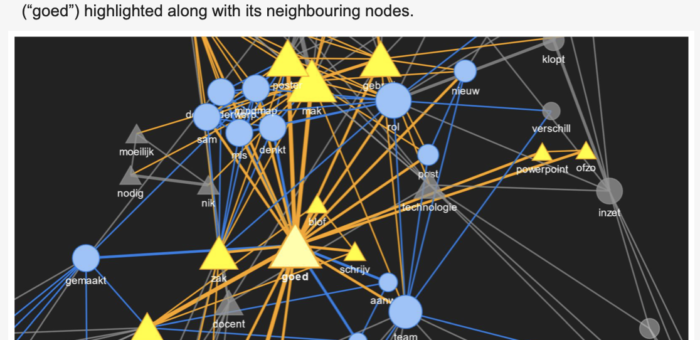
Collaboration is an important 21st Century skill. Co-located (or face-to-face) collaboration (CC) analytics gained momentum with the advent of sensor technology. Most of these works have used the audio modality to detect the quality of CC. The CC quality can be detected from simple indicators of collaboration such as total speaking time or complex indicators like synchrony in the rise and fall of the average pitch. Most studies in the past focused on “how group members talk” (i.e., spectral, temporal features of audio like pitch) and not “what they talk”. The “what” of the conversations is more overt contrary to the “how” of the conversations. Very few studies studied “what” group members talk about, and these studies were lab based showing a representative overview of specific words as topic clusters…

Read More
New Pub: A four-country cross-case analysis of academic staff expectations about learning analytics in higher education

New Pub: A four-country cross-case analysis of academic staff expectations about learning analytics in higher education

Higher Education, Journal, Learning Analytics, Open access, Publication
The purpose of this paper is to explore the expectations of academic staff to learning analytics services from an ideal as well as a realistic perspective. This mixed-method study focused on a cross-case analysis of staff from Higher Education Institutions from four European universities (Spain, Estonia, Netherlands, UK). While there are some differences between the countries as well as between ideal and predicted expectations, the overarching results indicate that academic staff sees learning analytics as a tool to understand the learning activities and possibility to provide feedback for the students and adapt the curriculum to meet learners' needs. However, one of the findings from the study across cases is the generally consistently low expectation and desire for academic staff to be obligated to act based on data that shows students…
Read More
New Pub: Understanding Graph Problem solving with the use of Eye-tracking and Epistemic Network Analysis

New Pub: Understanding Graph Problem solving with the use of Eye-tracking and Epistemic Network Analysis

Journal, Multimodal Learning Analytics, Open access, Publication, School
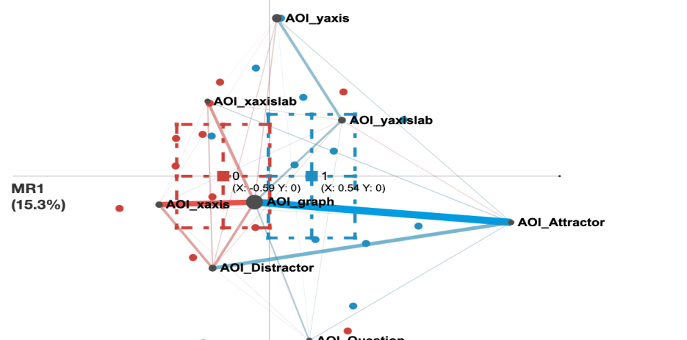
Epistemic Network Analyses of Economics Students’ Graph Understanding: An Eye-Tracking Study Learning to solve graph tasks is one of the key prerequisites of acquiring domain-specific knowledge in most study domains. Analyses of graph understanding often use eye-tracking and focus on analyzing how much time students spend gazing at particular areas of a graph—Areas of Interest (AOIs). To gain a deeper insight into students’ task-solving process, we argue that the gaze shifts between students’ fixations on different AOIs (so-termed transitions) also need to be included in holistic analyses of graph understanding that consider the importance of transitions for the task-solving process. Thus, we introduced Epistemic Network Analysis (ENA) as a novel approach to analyze eye-tracking data of 23 university students who solved eight multiple-choice graph tasks in physics and economics. ENA…
Read More