
New Pub: Superpowers in the Classroom: Hyperchalk is an Online Whiteboard for Learning Analytics Data Collection

New Pub: Superpowers in the Classroom: Hyperchalk is an Online Whiteboard for Learning Analytics Data Collection

Computer-supported collaborative learning, Conference, Conference, Event, Further Education, General education, Higher Education, Learning Analytics, Lifelong Learning, Publication, School, Technical paper
A new system demonstration paper authored by Lukas Menzel, Sebastian Gombert, Daniele Di Mitri and Henrik Drachsler has been released as part of the ECTEL 2022 proceedings. In this paper, we present Hyperchalk, a self-hosted collaborative online whiteboard software. Similar to commercial solutions like Miro or Flinga, this software provides users with collaborative boards which they can use to draw, write or sketch together. However, unlike commercial solutions, Hyperchalk allows for collecting rich log data, which can be used to study the behaviour of its users and to allow Learning Analytics and studies on computer-supported collaborative learning. Moreover, Hyperchalk comes with a built-in replay mode which allows watching how users behave in its spaces. It supports the LTI1.3 standard, which enables seamless integration with learning management systems such as Moodle,…
Read More
Team of EduTec and TBA Members Wins Runners-Up Prize @ NAEP Reading Automated Scoring Challenge

Team of EduTec and TBA Members Wins Runners-Up Prize @ NAEP Reading Automated Scoring Challenge

Artificial Intelligence, Assessment, Award, Computational Psychometrics, School
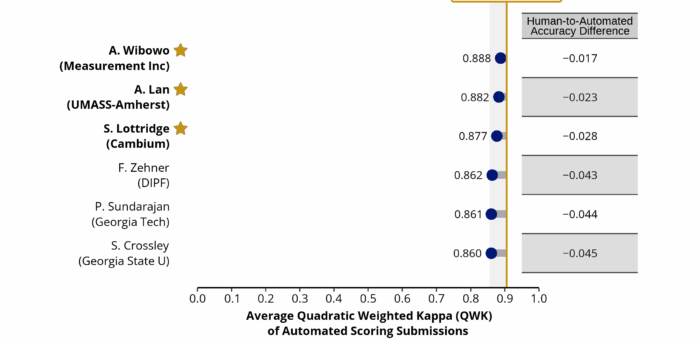
The NAEP Reading Automated Scoring Challenge was a competition which was held in late 2021 by the National Center for Education (USA). The goal was to evaluate the applicability of natural language processing methodology to the task of scoring of large scale constructed response assessment data. In addition to this, participating models were also required to be interpretable and free of algorithmic bias against different student demographics. The data set which was used to evaluate the systems consisted of responses from 4th and 8th grade school student to 20 different reading comprehension tasks. More than a dozen different teams from universities and private assessment companies submitted contributions. Out of these, 12 contributions, including ours, were selected as eligible with respect to interpretability and algorithmic fairness. These contributions were then ranked…
Read More